

Managing customer relationships is essential for businesses that want to increase sales, improve customer satisfaction, and streamline daily operations. With so many CRM platforms available, choosing the right one can be challenging. Salesforce CRM is one of the most popular and widely used customer relationship management solutions, trusted by businesses of all sizes—from startups to global enterprises.
In this Salesforce CRM review, we’ll take an in-depth look at its features, pricing, ease of use, integrations, advantages, disadvantages, and overall value. Whether you’re a small business owner looking for your first CRM or a growing company seeking advanced sales automation, this review will help you determine whether Salesforce CRM is the right fit for your needs.
We tested Salesforce CRM by exploring its core features, user interface, customization options, and pricing structure. We also reviewed feedback from businesses and CRM professionals to provide a balanced and practical review.
What Is Salesforce CRM?
Salesforce CRM is a cloud-based customer relationship management (CRM) platform designed to help businesses manage customer interactions, track sales opportunities, automate workflows, and improve team collaboration. Founded in 1999, Salesforce has become one of the world’s leading CRM providers, serving businesses across industries such as healthcare, finance, retail, manufacturing, technology, and professional services.
The platform centralizes customer data in a single dashboard, allowing sales, marketing, and customer support teams to access real-time information from anywhere. This unified approach helps businesses build stronger customer relationships, improve productivity, and make data-driven decisions.
One of Salesforce CRM’s biggest strengths is its flexibility. Businesses can customize dashboards, workflows, reports, and automation tools to match their specific processes. It also offers an extensive marketplace of third-party integrations through AppExchange, enabling users to connect Salesforce with hundreds of business applications.
Salesforce CRM is available in multiple editions, making it suitable for startups, small businesses, mid-sized companies, and large enterprises. While it offers powerful features and virtually unlimited scalability, it has a steeper learning curve than many other CRM solutions, making it best suited for organizations that need advanced customization and automation capabilities.
Our Experience
During our evaluation, we found Salesforce CRM to be one of the most feature-rich CRM platforms available. The dashboard is highly customizable, and the automation tools are impressive. However, first-time users may need some time to become comfortable with the platform because of its extensive features.
Key Features of Salesforce CRM
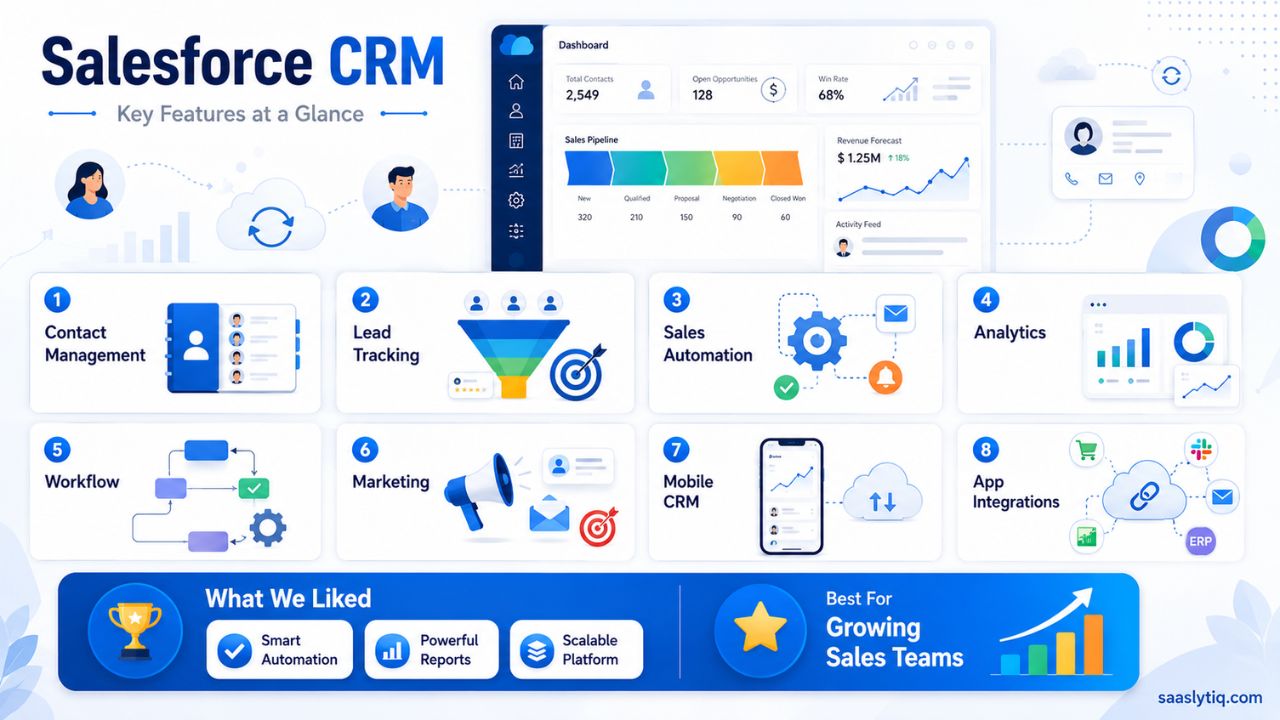
Salesforce CRM offers a comprehensive set of features that help businesses manage customer relationships, streamline sales processes, and improve team productivity. Here are some of its standout capabilities:
Contact and Account Management
Salesforce stores all customer and prospect information in one centralized database. Your team can easily access contact details, communication history, purchase records, and important notes, ensuring every interaction is personalized and informed.
Lead and Opportunity Management
The platform helps businesses capture, organize, and nurture leads throughout the sales pipeline. Sales representatives can track opportunities, monitor deal progress, prioritize high-value prospects, and increase their chances of closing more sales.
Sales Automation
Salesforce automates repetitive tasks such as follow-up reminders, lead assignments, approval processes, and email notifications. This allows sales teams to spend more time building relationships and less time on manual administrative work.
Reports and Analytics
Salesforce provides customizable dashboards and real-time reporting tools that help businesses measure sales performance, monitor KPIs, forecast revenue, and identify trends. These insights support smarter, data-driven decision-making.
Workflow Automation
With powerful automation tools, businesses can create custom workflows that reduce manual effort and improve operational efficiency. Automated processes ensure tasks are completed consistently while minimizing human error.
Marketing Integration
Salesforce integrates seamlessly with marketing tools, allowing businesses to manage campaigns, track customer engagement, and measure marketing performance. This helps align sales and marketing teams for better lead generation and customer conversion.
Mobile CRM
The Salesforce mobile app gives users access to customer information, sales activities, reports, and dashboards from anywhere. Sales representatives can update records, respond to customers, and manage deals while working remotely or traveling.
AppExchange Integrations
Salesforce offers access to AppExchange, one of the largest business app marketplaces. Users can connect Salesforce with accounting software, communication platforms, eCommerce tools, customer support systems, and thousands of other applications to extend its functionality.
What We Liked
The workflow automation and reporting tools stood out during our review. Businesses with growing sales teams will benefit from the platform’s flexibility and ability to automate repetitive tasks.
Salesforce CRM Pricing
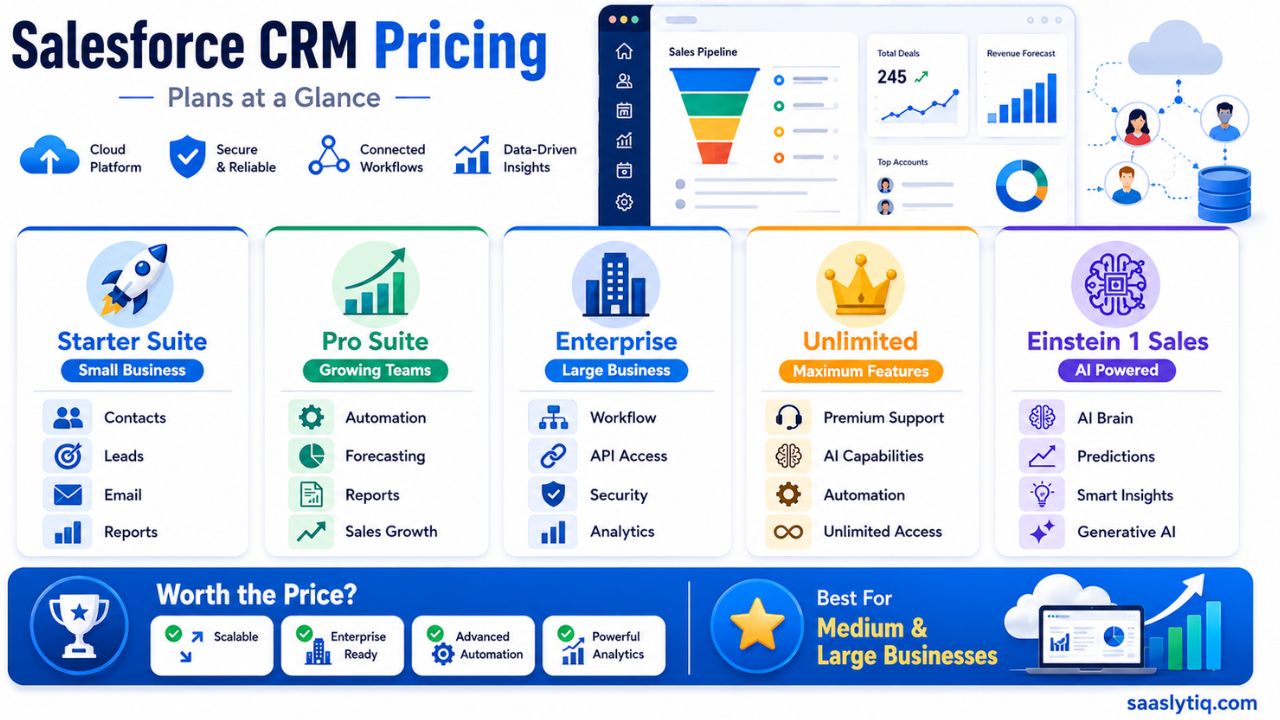
Salesforce CRM offers several pricing plans designed to meet the needs of businesses of different sizes. Whether you’re a small business looking for essential CRM tools or a large enterprise requiring advanced automation and AI-powered insights, Salesforce provides flexible options.
Starter Suite
The Starter Suite is ideal for small businesses that need basic CRM functionality. It includes contact management, lead tracking, email integration, reporting, and simple sales automation, making it a good choice for businesses just getting started with CRM software.
Pro Suite
The Pro Suite adds more advanced features, including enhanced automation, forecasting, customizable reports, and greater flexibility for growing teams. It’s designed for businesses that need more control over their sales processes.
Enterprise
The Enterprise plan is built for medium to large organizations. It offers advanced workflow automation, extensive customization, role-based permissions, API access, and powerful analytics to support complex business operations.
Unlimited
The Unlimited plan includes nearly every Salesforce feature, along with premium support, advanced AI capabilities, additional automation tools, and higher usage limits. It’s best suited for large enterprises with sophisticated CRM requirements.
Einstein 1 Sales
This premium edition combines Salesforce’s CRM platform with advanced AI-powered features through Einstein AI. It helps businesses improve productivity with predictive insights, intelligent recommendations, and generative AI capabilities for sales teams.
Is Salesforce CRM Worth the Price?
Salesforce CRM is one of the more expensive CRM platforms on the market, but its pricing reflects the extensive features, scalability, and customization it provides. Businesses that need advanced sales automation, detailed reporting, and enterprise-level capabilities often find the investment worthwhile. However, startups and small businesses with limited budgets may prefer more affordable alternatives if they don’t require Salesforce’s full range of features.
Note: Salesforce updates its pricing and features periodically. Always check the official Salesforce website for the latest plans and pricing before making a purchase decision.
Pricing Summary
| Category | Rating |
|---|---|
| Affordability | ⭐⭐⭐☆☆ |
| Features | ⭐⭐⭐⭐⭐ |
| Scalability | ⭐⭐⭐⭐⭐ |
| Value for Large Businesses | ⭐⭐⭐⭐⭐ |
| Value for Small Businesses | ⭐⭐⭐⭐☆ |
Our Opinion
Salesforce CRM delivers excellent value for medium and large businesses that need advanced CRM capabilities. For startups with limited budgets, the pricing may feel expensive compared to simpler alternatives.
Salesforce CRM Pros and Cons
Like any CRM platform, Salesforce CRM has both strengths and limitations. Understanding its advantages and drawbacks can help you decide whether it’s the right solution for your business.
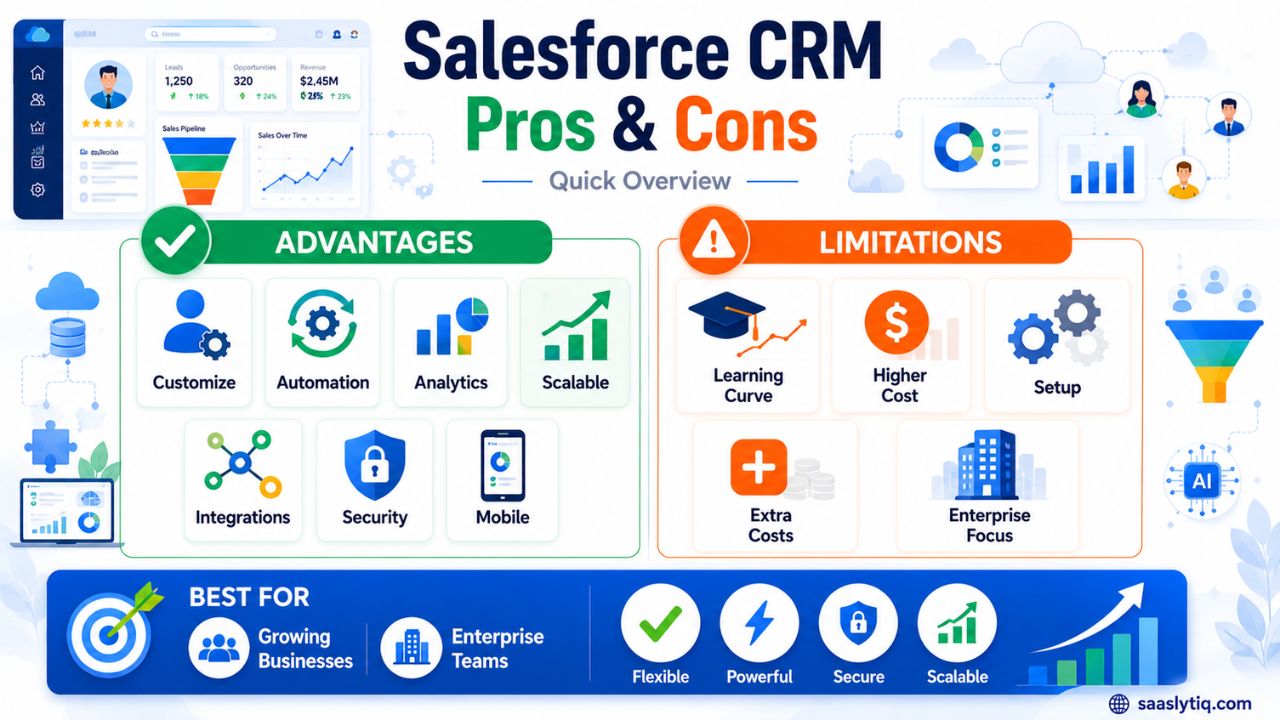
Pros
- Highly customizable: Salesforce allows businesses to customize dashboards, workflows, reports, and fields to match their unique sales processes.
- Powerful sales automation: Automate repetitive tasks, lead assignments, follow-ups, approvals, and workflows to improve team productivity.
- Comprehensive reporting: Real-time dashboards and advanced analytics provide valuable insights into sales performance and customer behavior.
- Excellent scalability: Whether you’re a startup or a global enterprise, Salesforce can grow with your business and support increasing operational needs.
- Extensive integrations: Connect with thousands of third-party applications through AppExchange, including marketing, accounting, customer support, and productivity tools.
- Strong security: Enterprise-grade security features, role-based access controls, and compliance certifications help protect sensitive customer data.
- Mobile accessibility: The Salesforce mobile app enables users to manage leads, contacts, opportunities, and reports from anywhere.
Cons
- Steep learning curve: Due to its extensive features and customization options, new users may need time and training to become proficient.
- Higher pricing: Salesforce is generally more expensive than many competing CRM platforms, especially for advanced plans and add-on features.
- Complex setup: Initial implementation and customization can require technical expertise or assistance from Salesforce consultants.
- Additional costs: Some advanced features, integrations, and AI capabilities may require purchasing extra products or higher-tier plans.
- May be excessive for small businesses: Companies with simple sales processes may find Salesforce more powerful—and more complex—than they actually need.
Overall Assessment
Salesforce CRM stands out for its flexibility, automation, scalability, and enterprise-grade capabilities. While its pricing and learning curve may be challenging for some small businesses, organizations that require advanced CRM functionality and long-term growth potential will likely find it to be a valuable investment.
Our Salesforce CRM Rating
After evaluating Salesforce CRM’s features, ease of use, pricing, customization options, customer support, and overall performance, here’s our overall assessment:
| Category | Rating |
| Ease of Use | 4.2/5 |
| Features | 5.0/5 |
| Customization | 5.0/5 |
| Pricing | 3.8/5 |
| Customer Support | 4.6/5 |
| Overall Rating | 4.7/5 |
Our Verdict: Salesforce CRM is an excellent choice for businesses that need a powerful, scalable, and highly customizable CRM platform. While it comes with a learning curve and a higher price point, its advanced automation, reporting, and integration capabilities make it a worthwhile investment for growing businesses and enterprises.
Final Verdict
Salesforce CRM is one of the most powerful CRM platforms available, offering advanced sales automation, customizable workflows, detailed reporting, and thousands of integrations. It’s an excellent choice for growing businesses and large enterprises that need a scalable CRM solution.
However, its higher pricing and learning curve may not suit every business. If your company requires advanced features and long-term scalability, Salesforce CRM is a worthwhile investment. Smaller businesses with basic CRM needs may prefer a simpler and more affordable alternative.
Related CRM Guides
If you’re exploring CRM software for a specific industry, these detailed guides can help you choose the right solution for your business:
- Best CRM for Dentists – Discover the top CRM solutions designed to help dental practices manage appointments, patient communication, and follow-ups.
- Best CRM for HVAC – Compare the best CRM platforms for HVAC businesses to improve scheduling, customer management, and sales.
- Best CRM for Real Estate – Explore the top CRM software for real estate agents and agencies to manage leads, automate follow-ups, and close more deals.
- HubSpot CRM Review – Read our detailed HubSpot CRM review to explore its key features, pricing, pros and cons, and find out whether it’s the right CRM solution for your business.
- Zoho CRM Review – Read our detailed Zoho CRM review to explore its key features, pricing, pros and cons, and discover whether it’s the right CRM solution for your business.
Frequently Asked Questions (FAQs)
Is Salesforce CRM free?
No. Salesforce CRM offers paid plans, although free trials are available for selected products.
Is Salesforce CRM good for small businesses?
Yes, but it is best suited for businesses that expect to grow and need advanced CRM features.
What industries use Salesforce CRM?
Salesforce is used across industries, including healthcare, finance, retail, manufacturing, technology, education, and professional services.
Does Salesforce CRM integrate with other tools?
Yes. Salesforce integrates with thousands of third-party applications through AppExchange, including marketing, accounting, and customer support tools.
Is Salesforce CRM easy to use?
Salesforce has a user-friendly interface, but its advanced features can take time to learn, especially for beginners.