

Managing an HVAC business involves much more than scheduling service calls. You need to track leads, follow up with customers, manage estimates, organize maintenance agreements, and keep your technicians on schedule. As your business grows, handling these tasks with spreadsheets or paper records becomes difficult. That is where the best CRM for HVAC businesses can make a real difference. A CRM (Customer Relationship Management) system helps you organize customer information, improve communication, and streamline daily operations from one place.
Unlike a general CRM, an HVAC CRM is built to support the needs of heating, ventilation, and air conditioning companies. It combines customer management with tools such as job scheduling, technician dispatching, invoicing, service history tracking, and automated reminders. Whether you run a small HVAC company or manage multiple service teams, the right CRM can help you respond faster, reduce missed opportunities, and deliver a better customer experience. It also gives you valuable insights into your sales pipeline and business performance, making it easier to make informed decisions.
In this guide, we will explain everything you need to know about choosing the best CRM for HVAC businesses. You will learn what an HVAC CRM is, the features that matter most, the benefits it offers, pricing expectations, and how to compare the leading CRM software available today. We will also share practical tips to help you choose a solution that fits your budget, supports your workflow, and helps your HVAC business grow with confidence.
What Is an HVAC CRM?
An HVAC CRM is a Customer Relationship Management system designed specifically for heating, ventilation, and air conditioning businesses. It helps contractors manage customer information, track leads, schedule service appointments, create estimates, send invoices, and monitor every interaction from a single dashboard. Instead of using multiple tools for different tasks, an HVAC CRM keeps everything organized in one place, making daily operations faster and more efficient.
A traditional CRM mainly focuses on managing sales and customer relationships. An HVAC CRM goes much further. It includes features that support field service businesses, such as technician scheduling, job dispatching, maintenance agreement tracking, work order management, and service history. These industry-specific tools help HVAC companies handle both office operations and field activities without switching between different software.
For example, when a customer requests an air conditioner repair, the CRM records the inquiry, stores the customer’s contact details, schedules the appointment, assigns the nearest technician, and saves the complete service history after the job is finished. If the customer needs regular HVAC maintenance, the system can automatically send reminders for future inspections. This creates a smoother experience for both the business and its customers.
An HVAC CRM also improves communication between office staff and field technicians. Office teams can schedule jobs, update customer records, and monitor technician availability in real time. Field technicians can access customer information, previous service records, equipment details, and job notes directly from their mobile devices. This reduces errors, saves time, and allows technicians to provide better service during every visit.
As HVAC businesses grow, managing hundreds or even thousands of customers becomes more challenging. An HVAC CRM keeps every customer interaction organized, helping businesses avoid missed appointments, forgotten follow-ups, and lost sales opportunities. It also provides detailed reports that help business owners understand sales performance, technician productivity, customer retention, and revenue trends.
How Is an HVAC CRM Different from a Generic CRM?
Many businesses use general-purpose CRM software to manage contacts and sales. However, HVAC companies require tools that support field service operations and recurring maintenance work. An HVAC CRM is built to meet these specific needs.
| Feature | Generic CRM | HVAC CRM |
| Customer Contact Management | Yes | Yes |
| Lead Tracking | Yes | Yes |
| Sales Pipeline Management | Yes | Yes |
| Technician Scheduling | Limited | Yes |
| Job Dispatching | No | Yes |
| Work Order Management | No | Yes |
| Equipment & Service History | Limited | Yes |
| Preventive Maintenance Reminders | No | Yes |
| Estimate & Invoice Management | Sometimes | Yes |
| Mobile Access for Field Technicians | Limited | Yes |
| Maintenance Agreement Tracking | No | Yes |
Because of these specialized features, the best CRM for HVAC businesses helps reduce manual work and improves productivity. It allows business owners to manage customer relationships, service operations, and sales from a single platform.
Who Should Use an HVAC CRM?
An HVAC CRM is a valuable solution for businesses of all sizes, including:
- Residential HVAC contractors
- Commercial HVAC service providers
- Heating and cooling companies
- Air conditioning installation businesses
- HVAC repair companies
- Preventive maintenance service providers
- Multi-location HVAC businesses
- Independent HVAC technicians looking to grow their customer base
Whether you are handling a few service calls each week or managing multiple technicians across different locations, an HVAC CRM helps organize your workflow, improve customer communication, and increase operational efficiency.
At SaaSlytiq, we review and compare industry-specific CRM software to help businesses choose the right solution. In the following sections, you’ll discover the essential features, top CRM platforms, pricing, and expert tips to help you select the best HVAC CRM for your business.
Why HVAC Businesses Need a CRM
Running an HVAC business requires more than technical skills. Every day, you have to manage new leads, answer customer calls, schedule appointments, dispatch technicians, send estimates, create invoices, and follow up after every job. As your customer base grows, handling these tasks manually becomes difficult. Missed appointments, delayed responses, and poor communication can quickly affect customer satisfaction and revenue.
The best CRM for HVAC businesses helps solve these challenges by bringing your sales, customer management, and field service operations into one system. Instead of searching through spreadsheets, notebooks, or multiple software tools, your team can access accurate customer information, job details, and service history whenever they need it. This improves efficiency and helps your business deliver a professional experience from the first phone call to the final invoice.
An HVAC CRM also supports long-term business growth. It helps you build stronger customer relationships, increase repeat business, and make smarter decisions using real-time reports and business insights. Whether you operate a small local HVAC company or manage multiple service teams, a CRM gives you better control over your daily operations.
Never Lose a Lead
Every inquiry is a potential customer. Without a proper system, it is easy to forget follow-up calls or lose contact information.
An HVAC CRM automatically captures leads from your website, phone calls, email, or online forms. It stores customer details, tracks every interaction, and reminds your team to follow up at the right time. This helps you convert more prospects into paying customers and reduces lost sales opportunities.
Deliver Faster Customer Service
Customers expect quick responses and reliable service. If your team cannot find customer records or previous job details, every interaction takes longer.
An HVAC CRM keeps complete customer profiles in one place, including contact information, service history, installed equipment, maintenance agreements, and previous invoices. Your staff and technicians can access this information within seconds, allowing them to provide faster and more personalized support.
Simplify Scheduling and Technician Dispatch
Scheduling jobs manually often leads to double bookings, missed appointments, or inefficient routes.
An HVAC CRM allows office staff to assign jobs based on technician availability, location, and workload. Real-time scheduling helps reduce travel time and ensures technicians arrive at appointments on time. Many HVAC CRM platforms also include mobile apps, allowing field technicians to receive updates instantly.
Build Stronger Customer Relationships
Most HVAC companies depend on repeat customers for maintenance contracts, seasonal inspections, and future repairs.
A CRM helps you stay connected by sending appointment reminders, maintenance notifications, follow-up emails, and service updates automatically. Regular communication builds trust, improves customer satisfaction, and increases customer retention.
Increase Team Productivity
When information is scattered across different systems, employees spend valuable time searching for customer records or updating paperwork.
An HVAC CRM automates many daily tasks, including lead management, follow-up reminders, estimate generation, invoicing, and reporting. Automation reduces manual work so your team can focus on serving customers and growing the business.
Make Better Business Decisions
Successful HVAC businesses rely on accurate data, not guesswork.
A CRM provides detailed reports on sales performance, lead conversion rates, technician productivity, customer retention, revenue trends, and completed jobs. These insights help business owners identify what is working, improve weak areas, and plan future growth with confidence.
Support Long-Term Business Growth
As your HVAC company expands, managing more customers and technicians becomes increasingly complex.
An HVAC CRM grows with your business. It keeps customer data organized, standardizes workflows, and improves collaboration between office staff and field technicians. This creates a strong foundation that supports sustainable growth without increasing administrative workload.
Key Benefits at a Glance
Businesses that invest in the best HVAC CRM software often experience measurable improvements, including:
- Faster response times for new customer inquiries
- Better lead tracking and higher conversion rates
- More efficient job scheduling and technician dispatch
- Improved customer communication and satisfaction
- Increased repeat business through maintenance reminders
- Less manual paperwork and fewer administrative errors
- Better visibility into sales, operations, and business performance
- Higher productivity across office and field teams
- Greater revenue through organized customer management
An HVAC CRM is no longer just a tool for storing customer contacts. It has become an essential business platform that helps HVAC companies streamline operations, improve customer service, and create consistent growth in a competitive market.
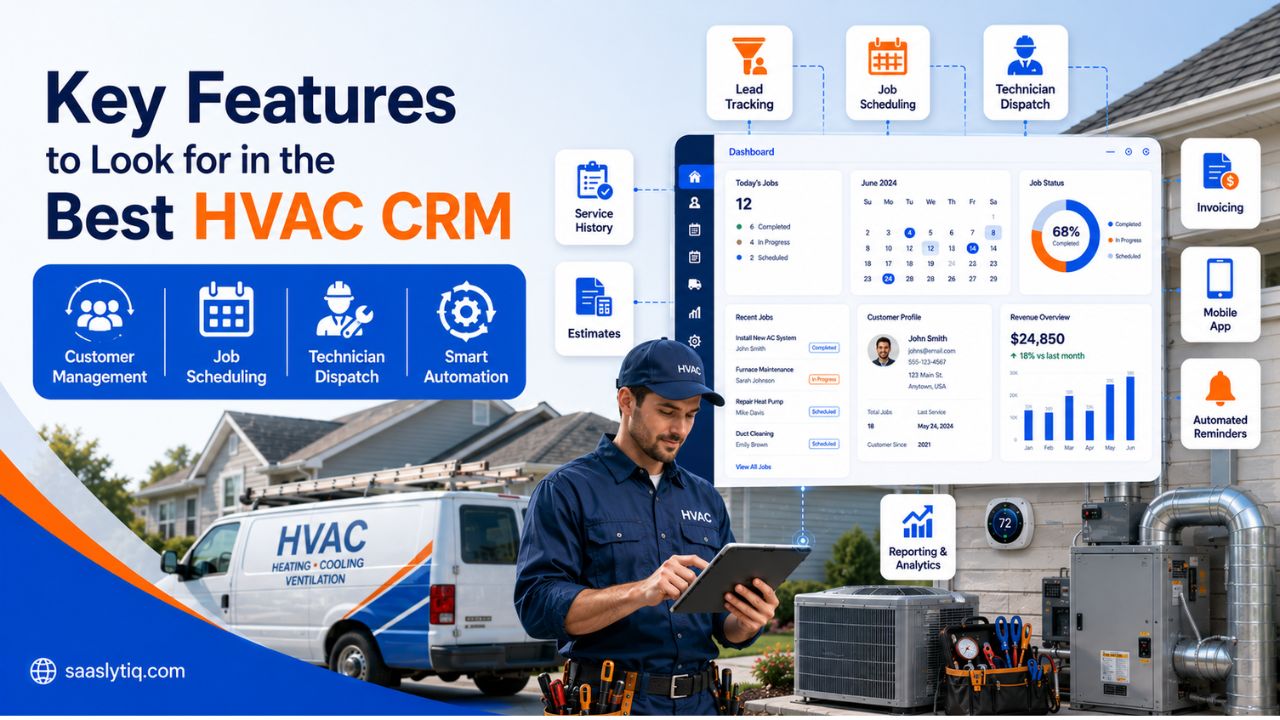
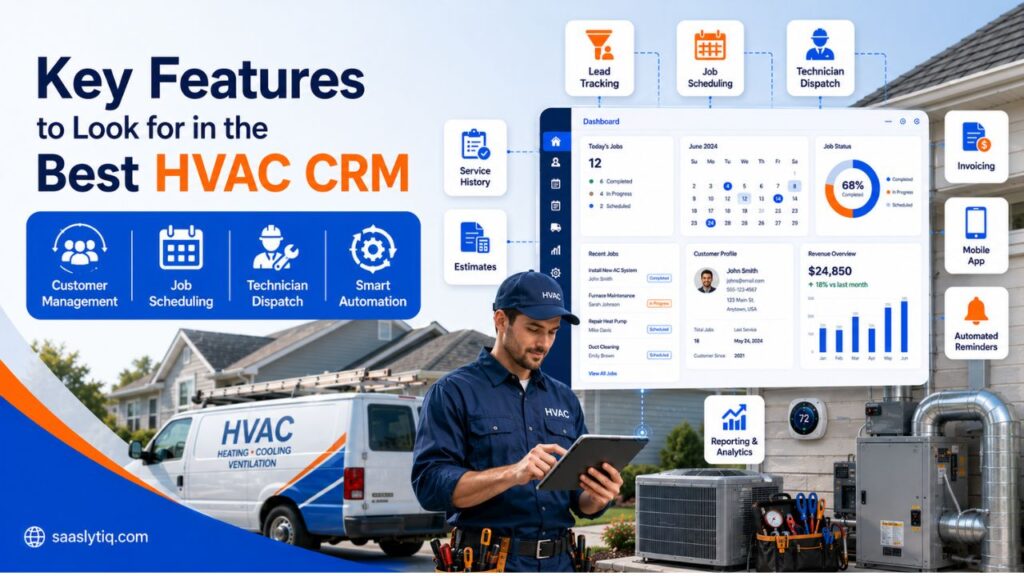
Key Features to Look for in the Best HVAC CRM
Not every CRM is designed for HVAC businesses. While many platforms offer basic contact management, the best CRM for HVAC companies includes features that simplify field service operations, improve customer communication, and help teams work more efficiently. Before choosing a CRM, make sure it offers the tools your business needs today and can support your growth in the future.
Customer Management
Every successful HVAC business starts with strong customer relationships. A good CRM stores all customer information in one secure place, including contact details, property addresses, installed HVAC systems, service history, invoices, warranties, and communication records.
With a complete customer profile, your office staff and technicians can quickly understand a customer’s history before every service visit. This leads to faster support and a more personalized customer experience.
Lead Tracking and Sales Pipeline
Every phone call, website form, or referral is a potential customer. Without a proper system, valuable leads can easily be forgotten.
An HVAC CRM tracks every lead from the first inquiry to the completed job. It shows where each prospect is in the sales process, reminds your team about follow-ups, and helps convert more estimates into paying customers.
Job Scheduling and Calendar Management
Scheduling is one of the most important parts of an HVAC business. A modern CRM provides an easy-to-use calendar that helps office staff schedule installations, repairs, inspections, and maintenance visits.
Real-time scheduling reduces double bookings and allows managers to adjust appointments when emergencies or cancellations occur.
Technician Dispatching
Sending the right technician to the right job saves both time and money.
The best HVAC CRM software allows dispatchers to assign jobs based on technician availability, location, skills, and workload. Some systems also use GPS tracking to optimize travel routes, helping technicians arrive on time while reducing fuel costs.
Mobile Access for Field Technicians
HVAC technicians spend most of their time on the road, not in the office.
A mobile-friendly CRM lets technicians view schedules, customer information, equipment history, work orders, and job notes directly from their smartphones or tablets. They can also update job status, upload photos, collect customer signatures, and complete service reports without returning to the office.
Estimate and Quote Management
Creating professional estimates quickly helps businesses win more jobs.
A quality HVAC CRM allows you to build detailed quotes using customizable templates. You can include labor, equipment, materials, taxes, and discounts while sending estimates directly to customers through email.
Some CRM platforms also notify you when a customer opens or approves a quote.
Invoicing and Payment Processing
After completing a job, customers expect a simple payment process.
Many HVAC CRM platforms generate invoices automatically from completed work orders. Some also support online payments, allowing customers to pay by credit card, bank transfer, or digital wallet. Faster payments improve cash flow and reduce the time spent chasing unpaid invoices.
Preventive Maintenance Management
Many HVAC companies generate recurring income through maintenance contracts.
An HVAC CRM keeps track of maintenance agreements and automatically reminds customers when it’s time for seasonal inspections or routine servicing. This helps increase repeat business while reducing emergency repair calls.
Work Order Management
Managing multiple service requests manually can quickly become confusing.
A CRM organizes every work order from start to finish. Office staff can assign jobs, technicians can update progress in real time, and managers can monitor completed work without searching through paperwork.
Service History Tracking
Every customer interaction tells an important story.
An HVAC CRM records previous repairs, equipment installations, replacement parts, warranty details, technician notes, and completed maintenance visits. Having this information available before every appointment helps technicians diagnose problems faster and recommend the right solutions.
Workflow Automation
Automation saves valuable time by reducing repetitive work.
The best CRM software for HVAC businesses can automatically:
- Send appointment confirmations
- Schedule follow-up reminders
- Deliver maintenance notifications
- Create recurring service tasks
- Send invoices after job completion
- Notify customers about technician arrival
- Assign leads to the appropriate sales representative
These automations improve efficiency while ensuring no important task is overlooked.
Reporting and Business Analytics
Growing an HVAC business requires accurate data.
A CRM provides dashboards and reports that show important business metrics, including:
- Lead conversion rates
- Revenue trends
- Technician productivity
- Customer retention
- Average job value
- Sales pipeline performance
- Monthly service appointments
These insights help business owners make smarter decisions based on real performance instead of assumptions.
Third-Party Integrations
Most HVAC companies already use accounting software, email marketing platforms, payment processors, and communication tools.
A modern HVAC CRM should integrate with popular business applications such as accounting software, online payment gateways, calendars, email platforms, and marketing automation tools. Integrations reduce manual data entry and create a smoother workflow across your business.
AI-Powered Features
Artificial intelligence is becoming a valuable part of modern CRM software.
Many leading HVAC CRM solutions now include AI features that can:
- Predict high-value sales opportunities
- Recommend the best follow-up actions
- Automate customer communication
- Generate reports instantly
- Analyze customer behavior
- Improve scheduling efficiency
These tools help businesses save time while delivering a better customer experience.
Essential HVAC CRM Features Checklist
| Feature | Why It Matters |
| Customer Management | Keeps all customer information organized |
| Lead Tracking | Helps convert more prospects into customers |
| Job Scheduling | Prevents missed appointments and double bookings |
| Technician Dispatch | Assigns the right technician to each job |
| Mobile App | Supports technicians in the field |
| Estimates & Quotes | Creates professional proposals quickly |
| Invoicing & Payments | Speeds up billing and improves cash flow |
| Maintenance Reminders | Increases repeat business and customer retention |
| Work Order Management | Organizes every service request efficiently |
| Service History | Gives technicians complete customer context |
| Workflow Automation | Reduces manual tasks and saves time |
| Reporting & Analytics | Supports data-driven business decisions |
| AI Features | Improves productivity and customer engagement |
| Software Integrations | Connects your existing business tools |
The right feature set can make a significant difference in your daily operations. Instead of choosing a CRM with the longest feature list, focus on one that matches the way your HVAC business operates. A well-designed HVAC CRM should simplify your workflow, improve customer service, and support your business as it continues to grow.
Benefits of Using an HVAC CRM
Investing in the best CRM for HVAC businesses is more than upgrading your software. It is about creating a smoother workflow, improving customer satisfaction, and building a business that can grow without unnecessary stress. Whether you have a small team or manage multiple service crews, an HVAC CRM helps you save time, reduce manual work, and increase revenue.
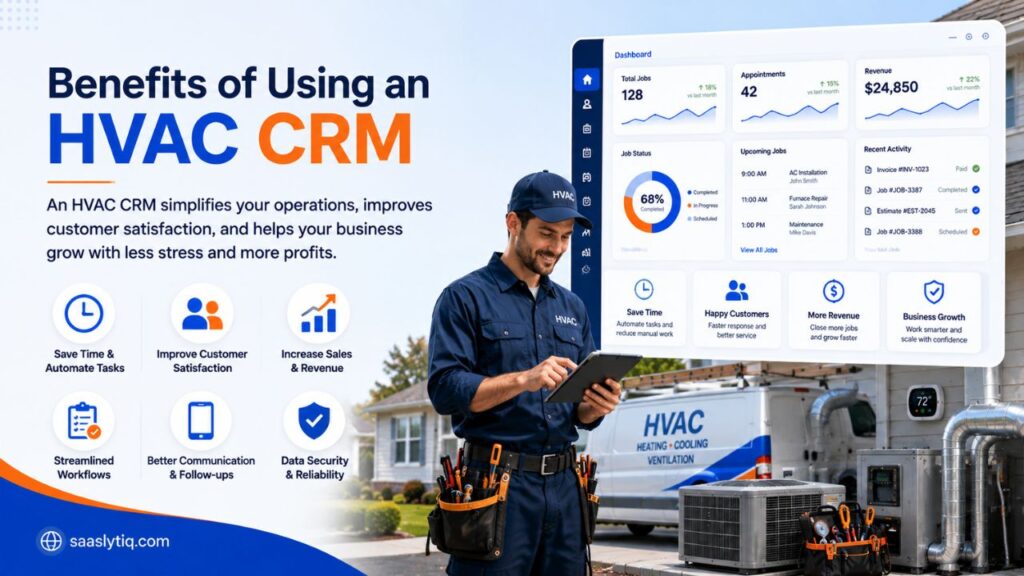
Here are the biggest benefits HVAC companies can expect from using a modern CRM.
Improve Customer Experience
Customer experience plays a major role in the success of every HVAC business. People expect fast responses, on-time service, and clear communication.
An HVAC CRM stores every customer interaction in one place. Your team can quickly access contact details, equipment information, previous repairs, maintenance history, and invoices before every service call. This allows technicians and office staff to provide personalized service without asking customers to repeat the same information.
Happy customers are more likely to leave positive reviews, renew maintenance agreements, and recommend your business to others.
Convert More Leads into Customers
Many HVAC companies lose potential customers simply because follow-ups are delayed or forgotten.
A CRM keeps every lead organized and reminds your sales team when to call, email, or send a quote. You can track where each prospect is in the sales pipeline and identify which opportunities need immediate attention.
Better lead management means more booked jobs and higher revenue.
Increase Technician Productivity
Technicians perform better when they have the information they need before arriving at a job site.
With mobile access, they can view customer history, equipment details, work orders, and technician notes directly from their phones or tablets. They spend less time calling the office and more time completing service calls.
This improves first-time fix rates and allows technicians to complete more jobs each day.
Reduce Administrative Work
Office staff often spend hours updating spreadsheets, creating invoices, scheduling appointments, and sending reminders.
An HVAC CRM automates many of these repetitive tasks. Appointment confirmations, follow-up emails, maintenance reminders, invoice generation, and recurring service schedules can all run automatically.
Automation reduces paperwork and allows your team to focus on serving customers instead of handling manual processes.
Schedule Jobs More Efficiently
Poor scheduling can lead to missed appointments, long travel times, and unhappy customers.
A CRM helps dispatchers assign jobs based on technician availability, location, and expertise. Real-time scheduling makes it easier to handle emergency service calls while keeping daily operations organized.
Efficient scheduling reduces downtime and increases the number of completed jobs.
Increase Customer Retention
Winning a new customer often costs more than keeping an existing one.
An HVAC CRM helps maintain long-term relationships by sending automatic maintenance reminders, service notifications, seasonal inspection alerts, and follow-up messages. Regular communication keeps your business top of mind and encourages customers to return whenever they need HVAC services.
Long-term customers also generate more referrals and recurring revenue.
Improve Team Collaboration
Office staff, sales representatives, and field technicians all need access to the same information.
A centralized CRM ensures everyone works from updated customer records. When one team member updates a job status or customer note, the information becomes available across the organization.
Better communication reduces mistakes and helps teams work together more efficiently.
Gain Better Business Insights
Growing a business requires accurate information.
Most HVAC CRM platforms include reporting dashboards that show key performance indicators such as:
- Total revenue
- Number of completed jobs
- Lead conversion rate
- Technician performance
- Customer retention rate
- Average job value
- Sales pipeline progress
These reports help business owners identify growth opportunities and make better business decisions.
Increase Revenue Over Time
An HVAC CRM creates multiple opportunities to increase revenue.
You can identify customers who are due for equipment replacements, promote maintenance plans, send seasonal service reminders, and follow up on unfinished estimates. These small improvements often lead to more booked appointments and higher customer lifetime value.
Instead of relying only on new customers, your business generates more income from existing relationships.
Support Business Growth
As your HVAC company expands, managing more customers, employees, and service calls becomes increasingly challenging.
A scalable CRM grows with your business. It keeps operations organized, standardizes processes, and allows you to manage larger workloads without increasing administrative complexity.
This makes expansion easier while maintaining high-quality customer service.
Return on Investment (ROI) of an HVAC CRM
Many HVAC business owners hesitate to invest in CRM software because of the monthly subscription cost. However, the long-term value usually outweighs the initial expense.
A well-implemented CRM can deliver a strong return on investment by helping businesses:
- Convert more leads into paying customers
- Reduce missed appointments
- Increase technician efficiency
- Improve customer retention
- Generate more recurring maintenance contracts
- Speed up invoicing and payments
- Reduce manual administrative work
- Improve overall team productivity
Even small improvements in these areas can have a significant impact on annual revenue.
HVAC CRM Benefits at a Glance
| Business Challenge | How an HVAC CRM Helps |
| Lost leads | Tracks every inquiry and automates follow-ups |
| Missed appointments | Simplifies scheduling and technician dispatch |
| Poor customer communication | Stores complete customer records and automates reminders |
| Manual paperwork | Automates repetitive administrative tasks |
| Low customer retention | Sends maintenance reminders and follow-up messages |
| Limited business insights | Provides reports and real-time analytics |
| Slow payment collection | Generates invoices and supports online payments |
| Business growth challenges | Scales operations with organized workflows |
An HVAC CRM is not just another software subscription. It is a long-term investment that helps businesses improve efficiency, strengthen customer relationships, and increase profitability. Companies that adopt the right CRM early are often better prepared to compete, grow, and deliver a consistent customer experience in an increasingly competitive HVAC market.
Internal Linking Suggestion: After learning about the benefits of HVAC CRM software, explore our detailed reviews of leading platforms such as HubSpot CRM, Jobber, and ServiceTitan on SaaSlytiq to see which solution best matches your business needs.
Frequently Asked Questions (FAQs)
What is the best CRM for HVAC businesses?
The best CRM for HVAC businesses depends on your company size, budget, and operational needs. If you need advanced field service management, platforms like ServiceTitan and Housecall Pro are popular choices. If your focus is sales, marketing, and customer relationship management, HubSpot CRM is an excellent option. The right CRM should help you manage leads, schedule jobs, communicate with customers, and grow your business efficiently.
Can a small HVAC business benefit from CRM software?
Yes. A CRM is valuable for both small and large HVAC companies. Small businesses can use it to organize customer information, schedule appointments, send estimates, automate follow-ups, and improve customer service. As your business grows, the CRM can scale with your operations.
How much does HVAC CRM software cost?
HVAC CRM pricing varies depending on the provider and the features included. Basic plans usually start around $20–$50 per user per month, while advanced field service management platforms can cost $100–$300+ per user per month. Enterprise solutions with custom features may have custom pricing.
What features should I look for in an HVAC CRM?
The most important features include:
- Customer contact management
- Lead tracking
- Job scheduling
- Technician dispatching
- Mobile app access
- Estimates and invoicing
- Work order management
- Maintenance reminders
- Reporting and analytics
- Workflow automation
- Third-party integrations
Choosing software with these features will help streamline your daily operations and improve customer satisfaction.
Can an HVAC CRM integrate with accounting software?
Yes. Most modern HVAC CRM platforms integrate with popular accounting tools, payment gateways, email marketing software, and calendar applications. These integrations reduce manual work and keep your business data synchronized across different systems.
Is cloud-based HVAC CRM better than desktop software?
For most businesses, cloud-based CRM software is the better choice. It allows office staff and technicians to access customer information from anywhere using a computer, tablet, or smartphone. Cloud solutions also receive automatic updates and require less maintenance than desktop software.
Does HVAC CRM help increase sales?
Yes. A CRM helps track every lead, automate follow-ups, organize your sales pipeline, and improve customer communication. These improvements often lead to higher conversion rates, increased repeat business, and better customer retention, all of which contribute to higher revenue.
How long does it take to implement an HVAC CRM?
Implementation time depends on the software and the size of your business. Small HVAC companies can often start using a CRM within a few days, while larger businesses with multiple teams and data migration requirements may need several weeks for a complete setup.
Conclusion
Choosing the best CRM for HVAC is one of the smartest investments you can make for your business. The right platform helps you manage customer relationships, organize service appointments, track leads, automate daily tasks, and improve communication between your office staff and field technicians. Instead of relying on manual processes, you can streamline operations and focus on delivering outstanding service to every customer.
Before making a decision, compare the features, pricing, integrations, and scalability of different CRM solutions. Consider your current business needs as well as your future growth plans. A CRM that supports your workflow today should also be able to grow with your company tomorrow.
At SaaSlytiq, our goal is to help you find the right software for your business. Explore our in-depth CRM reviews, detailed comparisons, buying guides, and industry-specific recommendations to confidently choose the best solution for your HVAC company. Whether you are a solo contractor or manage a large service team, the right CRM can help you improve efficiency, increase customer satisfaction, and grow your business faster.