

Success in real estate depends on building strong relationships and responding to leads at the right time. Whether you work as an independent real estate agent, manage a growing brokerage, or lead a team of agents, staying organized is essential. Every phone call, email, property inquiry, and follow-up can lead to a new sale. As your client list grows, managing everything with spreadsheets or manual notes becomes difficult. This is where the best CRM for real estate agents can make a real difference. A real estate CRM helps you organize contacts, track leads, manage property transactions, automate routine tasks, and deliver a better experience to every client. It saves time, improves communication, and allows you to focus on closing more deals instead of handling administrative work.
Unlike a general customer relationship management system, a real estate CRM is designed specifically for the needs of real estate professionals. It includes tools for lead capture, sales pipeline management, property tracking, appointment scheduling, email marketing, document storage, and workflow automation. Many platforms also integrate with popular real estate websites, MLS systems, calendars, and communication tools, making it easier to manage your entire business from one place. By keeping all client information and transaction details organized, a real estate CRM helps reduce missed opportunities, improve productivity, and build long-term relationships with buyers and sellers.
This guide will help you find the best CRM for real estate agents by comparing the leading software solutions available today. You’ll learn what a real estate CRM is, how it works, the key features to look for, the benefits it offers, pricing expectations, and how to choose the right platform for your business. We’ll also compare the top CRM software, explore the latest trends in artificial intelligence and automation, and answer common questions to help you make a confident buying decision. Whether you’re purchasing your first CRM or replacing your current system, this guide will help you choose a solution that supports your business today and as it grows in the future.
What Is a Real Estate CRM?
A Real Estate CRM (Customer Relationship Management) is software designed to help real estate agents, brokers, and property management companies manage client relationships, organize leads, and streamline the entire sales process. Instead of using spreadsheets, sticky notes, or multiple applications, a real estate CRM stores all your contacts, conversations, property details, appointments, and transaction records in one secure platform. This allows you to stay organized, respond to clients faster, and provide a better buying or selling experience.
The best CRM for real estate agents goes beyond basic contact management. It is built specifically for the real estate industry and includes features that support daily business operations. These features often include lead capture from your website and property portals, sales pipeline management, automated follow-ups, property matching, document storage, task management, and reporting. Many modern CRM platforms also integrate with MLS systems, email marketing software, digital signature tools, and calendar applications, making it easier to manage every stage of a real estate transaction from one dashboard.
How Is a Real Estate CRM Different from a Generic CRM?
A general CRM is designed to serve businesses across different industries, such as retail, healthcare, manufacturing, or finance. While it can manage contacts and sales activities, it often lacks the specialized tools that real estate professionals need.
A real estate CRM is built around the property sales cycle. It understands how buyers, sellers, investors, and agents interact throughout the transaction process. This industry-specific approach allows agents to manage listings, schedule property viewings, track offers, organize contracts, and nurture long-term client relationships more efficiently.
The table below highlights the main differences between a generic CRM and a real estate CRM.
| Feature | Generic CRM | Real Estate CRM |
| Contact Management | Yes | Yes |
| Lead Management | Yes | Yes |
| Property Listing Management | No | Yes |
| Buyer & Seller Tracking | Limited | Yes |
| Property Viewing Scheduling | No | Yes |
| Transaction Management | Basic | Advanced |
| MLS Integration | Rare | Available |
| Marketing Automation | Basic | Advanced |
| Document Management | Limited | Yes |
| Sales Pipeline for Real Estate | No | Yes |
Why Real Estate Businesses Need a Specialized CRM
Real estate transactions often take weeks or even months to complete. During this time, agents need to communicate regularly with buyers, sellers, lenders, inspectors, and legal professionals. Managing these interactions manually increases the risk of missed follow-ups and lost opportunities.
A specialized CRM helps you stay in control by organizing every interaction in one place. You can instantly view a client’s communication history, schedule future tasks, monitor transaction progress, and send personalized updates without searching through multiple systems.
For example, if a buyer is looking for a three-bedroom home within a specific budget, your CRM can store these preferences and remind you when a suitable property becomes available. Likewise, if a seller is preparing to list a property, the CRM can track inspections, paperwork, marketing activities, and closing deadlines.
Who Should Use a Real Estate CRM?
A real estate CRM is valuable for businesses of all sizes, including:
- Independent real estate agents
- Residential real estate agencies
- Commercial real estate firms
- Property management companies
- Real estate brokers
- Real estate teams
- Luxury property consultants
- Real estate investors
Whether you manage ten clients or several thousand, a CRM helps you stay organized and deliver a more professional service.
Why It Matters
Choosing the best CRM for real estate agents is about more than managing contacts. It is about creating a structured process for capturing leads, nurturing relationships, managing transactions, and growing your business. As competition continues to increase, agents who use industry-specific CRM software can work more efficiently, respond faster, and provide a better customer experience than those relying on manual methods.
A well-designed real estate CRM becomes the central hub of your business, helping you save time, improve productivity, and close more deals while building long-term relationships with your clients.
Key Features of the Best CRM for Real Estate Agents
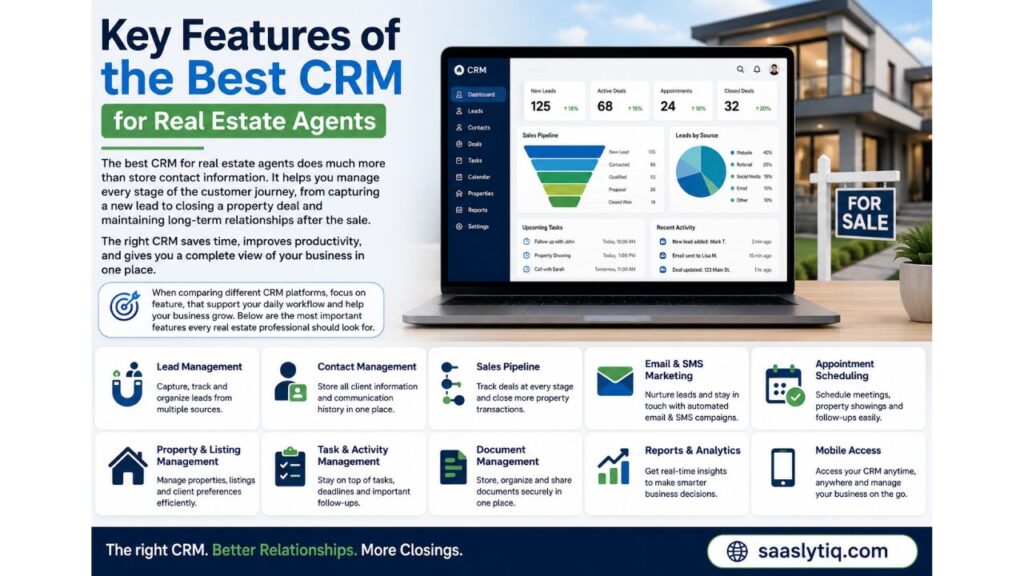
The best CRM for real estate agents does much more than store contact information. It helps you manage every stage of the customer journey, from capturing a new lead to closing a property deal and maintaining long-term relationships after the sale. The right CRM saves time, improves productivity, and gives you a complete view of your business in one place.
When comparing different CRM platforms, focus on features that support your daily workflow and help your business grow. Below are the most important features every real estate professional should look for.
Lead Capture and Management
Generating leads is only the first step. The real challenge is organizing those leads and following up at the right time. A real estate CRM automatically captures inquiries from multiple sources, including your website, landing pages, property portals, social media, Google Ads, and referrals.
Instead of manually entering contact details, every lead is added to your CRM with its source, contact information, and communication history. This makes it easier to track each prospect and prevents valuable opportunities from being lost.
A strong lead management system should also allow you to:
- Organize leads with tags and labels
- Assign leads to team members
- Track lead status
- Set follow-up reminders
- Monitor lead sources
- Score leads based on buying intent
These features help you focus on the prospects that are most likely to become clients.
Contact Management
Building strong relationships is the foundation of every successful real estate business. A CRM creates a complete profile for each client, allowing you to access important information whenever you need it.
A contact profile typically includes:
- Name and contact information
- Property preferences
- Budget range
- Preferred locations
- Communication history
- Meeting notes
- Documents and contracts
- Important follow-up dates
Having all client information in one place allows you to provide a more personalized experience and build long-term trust.
Sales Pipeline Management
Every buyer and seller moves through different stages before a transaction is completed. A CRM provides a visual sales pipeline that helps you understand exactly where each client is in the process.
A typical pipeline may include:
- New Lead
- Initial Contact
- Qualified Prospect
- Property Viewing
- Offer Submitted
- Negotiation
- Under Contract
- Closed Deal
This visual overview makes it easy to prioritize tasks, identify stalled opportunities, and forecast future sales.
Marketing Automation
Following up consistently is one of the most effective ways to convert leads into clients. However, sending every email manually takes time.
Marketing automation allows you to create workflows that automatically send:
- Welcome emails
- Property recommendations
- Appointment reminders
- Follow-up messages
- Monthly newsletters
- Market updates
- Holiday greetings
Automation ensures that every lead receives timely communication while allowing you to focus on higher-value activities.
Email and SMS Communication
Modern buyers and sellers expect fast responses. A CRM with built-in email and SMS tools allows you to communicate with clients without switching between different applications.
Many platforms offer features such as:
- Email templates
- Bulk email campaigns
- SMS reminders
- Email tracking
- Scheduled messages
- Communication history
Keeping all conversations inside the CRM gives you complete visibility into every client relationship.
Property and Listing Management
One of the biggest advantages of a real estate CRM is its ability to organize property information alongside client data.
Depending on the platform, you can:
- Store property listings
- Match buyers with suitable properties
- Track listing status
- Save property images and documents
- Record property history
- Monitor active and sold listings
This helps agents respond faster when clients ask about available properties.
Calendar and Appointment Scheduling
Real estate professionals manage property viewings, client meetings, inspections, and closing appointments every week. Missing an appointment can damage your reputation and reduce client confidence.
A CRM with calendar integration helps you:
- Schedule meetings
- Book property tours
- Set automatic reminders
- Track upcoming tasks
- Sync with Google Calendar or Outlook
A well-organized schedule helps you stay productive and avoid scheduling conflicts.
Document Management
Property transactions involve a large amount of paperwork. Keeping contracts and legal documents organized is essential.
A good CRM should allow you to:
- Upload contracts
- Store property documents
- Share files securely
- Organize inspection reports
- Save purchase agreements
- Access documents from any device
Centralized document management saves time and improves collaboration between agents, clients, and legal professionals.
Reporting and Analytics
Making business decisions based on data is much more effective than relying on guesswork. CRM reporting tools help you understand how your business is performing and where improvements can be made.
Useful reports include:
- New leads generated
- Lead conversion rate
- Closed transactions
- Sales revenue
- Marketing performance
- Agent productivity
- Customer retention
- Sales forecasts
These insights help you improve your marketing strategy and sales process over time.
Mobile Access
Real estate agents spend much of their day away from the office. A mobile CRM allows you to manage your business wherever you are.
With a mobile app, you can:
- Respond to new leads instantly
- Update client records
- Schedule appointments
- View property information
- Upload documents
- Track deal progress
This flexibility helps you provide faster service and stay connected while working in the field.
Third-Party Integrations
The best CRM software works seamlessly with the tools you already use. Integrations eliminate manual work and improve efficiency across your business.
Popular integrations include:
- Google Workspace
- Gmail
- Microsoft Outlook
- Google Calendar
- DocuSign
- Zoom
- QuickBooks
- Mailchimp
- MLS platforms
- Facebook Lead Ads
Connecting your CRM with these tools creates a smoother workflow and reduces duplicate data entry.
Artificial Intelligence and Automation
Artificial intelligence is changing the way real estate professionals manage leads and communicate with clients. Many modern CRM platforms now include AI-powered features that improve productivity and decision-making.
Common AI capabilities include:
- Lead scoring
- Predictive analytics
- Smart follow-up recommendations
- Email writing assistance
- Workflow automation
- Sales forecasting
- Customer behavior analysis
These tools help agents focus on high-value opportunities while reducing repetitive administrative work.
Security and Data Protection
Real estate businesses handle sensitive customer information, contracts, financial details, and legal documents. Protecting this data should be a top priority.
Choose a CRM that provides:
- Secure cloud storage
- Data encryption
- User access controls
- Two-factor authentication
- Automatic backups
- Compliance with privacy and security standards
Strong security features protect both your business and your clients from data breaches and unauthorized access.
Why These Features Matter
Choosing a CRM with the right features can have a significant impact on your business. It allows you to organize leads, improve client communication, automate routine tasks, and manage every property transaction more efficiently. As your business grows, these tools become even more valuable by helping your team stay organized, improve customer satisfaction, and close more deals.
Instead of selecting software based only on price, compare the features that will provide long-term value. The best CRM for real estate agents is one that fits your workflow, supports your business goals, and gives you the tools you need to build lasting client relationships and grow your real estate business with confidence.
Benefits of Using the Best CRM for Real Estate Agents
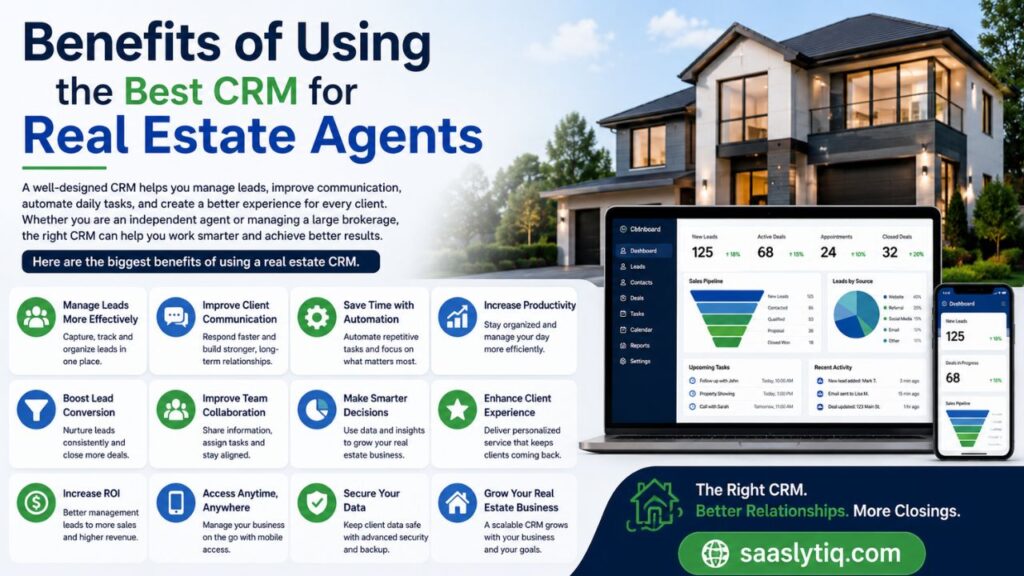
Choosing the best CRM for real estate agents is more than a technology upgrade. It is an investment in the future of your business. A well-designed CRM helps you manage leads, improve communication, automate daily tasks, and create a better experience for every client. Whether you are an independent agent or managing a large brokerage, the right CRM can help you work smarter and achieve better results.
Here are the biggest benefits of using a real estate CRM.
Manage Every Lead in One Place
Real estate leads come from many different sources, including your website, property portals, social media, referrals, and online advertising. Without a proper system, it is easy to lose track of potential clients.
A CRM automatically stores every lead in a central database, making it easy to view contact details, previous conversations, property interests, and follow-up activities. This organized approach helps ensure that no opportunity is overlooked.
Respond to Clients Faster
Speed plays an important role in the real estate industry. Buyers and sellers often contact multiple agents before making a decision. The agent who responds first has a better chance of building trust and winning the business.
A CRM helps improve response times by sending instant notifications when new leads arrive. It also allows you to automate welcome emails, text messages, and follow-up reminders, ensuring every inquiry receives timely attention.
Build Stronger Client Relationships
Successful real estate agents understand that long-term relationships are just as valuable as closing individual deals. Many clients return when they decide to buy or sell another property, and satisfied customers often recommend agents to friends and family.
A CRM keeps detailed records of every interaction, allowing you to remember important conversations, client preferences, and important dates. This helps you provide a more personal experience that strengthens trust and encourages repeat business.
Save Time with Automation
Many daily tasks in real estate are repetitive. Sending follow-up emails, scheduling appointments, assigning leads, updating records, and creating reminders can consume hours every week.
With workflow automation, your CRM can handle many of these routine tasks automatically. This reduces administrative work and gives you more time to focus on property viewings, negotiations, and client meetings.
Common tasks you can automate include:
- Lead assignments
- Email sequences
- SMS reminders
- Appointment confirmations
- Task creation
- Follow-up notifications
- Client nurturing campaigns
Increase Productivity
A CRM keeps your daily work organized by placing your contacts, properties, appointments, documents, and sales pipeline in one location.
Instead of switching between multiple applications, you can manage your business from a single dashboard. This streamlined workflow helps you complete tasks more efficiently and reduces unnecessary delays.
Improve Sales Pipeline Visibility
One of the biggest advantages of CRM software is the ability to monitor every stage of your sales process.
You can quickly see:
- New leads
- Active buyers
- Scheduled property viewings
- Offers under negotiation
- Contracts awaiting signatures
- Closed transactions
Having a clear overview of your pipeline helps you identify opportunities that need attention and forecast future revenue more accurately.
Close More Property Deals
Consistent communication is one of the main reasons successful agents outperform their competitors. A CRM ensures every lead receives regular follow-ups throughout the buying or selling journey.
By combining lead management, automated communication, and task reminders, you reduce the chances of losing prospects because of missed emails or delayed responses.
Better organization often leads to higher conversion rates and more successful property transactions.
Improve Team Collaboration
For agencies and brokerages, teamwork is essential. A CRM allows multiple users to access the same client information, making collaboration much easier.
Team members can:
- Share client notes
- Assign tasks
- Monitor transaction progress
- View communication history
- Track responsibilities
- Collaborate on deals
This creates a smoother workflow and ensures every client receives consistent service, regardless of which agent they work with.
Make Better Business Decisions
Modern CRM platforms include detailed reporting and analytics that help you understand how your business is performing.
You can track important metrics such as:
- Lead conversion rate
- Number of closed deals
- Average sales cycle
- Marketing performance
- Revenue growth
- Agent productivity
- Customer retention
- Top lead sources
These insights help you identify successful strategies and improve areas that need attention.
Strengthen Your Marketing Strategy
Many CRM systems include built-in marketing tools that help you attract and nurture potential clients.
These features often include:
- Email marketing
- Audience segmentation
- Automated campaigns
- Landing page integration
- Campaign tracking
- Performance reports
By understanding which marketing channels generate the highest-quality leads, you can invest your budget more effectively and improve your return on investment.
Enhance the Customer Experience
Today’s buyers and sellers expect clear communication and professional service throughout the transaction process.
A CRM helps you deliver a better customer experience by ensuring you:
- Respond quickly
- Keep clients informed
- Remember important preferences
- Schedule appointments efficiently
- Share relevant property updates
- Maintain regular communication
Satisfied clients are more likely to leave positive reviews, recommend your services, and return for future transactions.
Support Long-Term Business Growth
As your real estate business grows, manually managing hundreds or thousands of contacts becomes increasingly difficult.
A scalable CRM allows you to:
- Manage more leads without increasing administrative work
- Add new team members easily
- Standardize business processes
- Handle larger sales pipelines
- Improve operational efficiency
This allows your business to grow while maintaining a high level of customer service.
Improve Return on Investment (ROI)
Although CRM software requires a monthly investment, the long-term benefits often outweigh the cost.
A well-implemented CRM can help you:
- Convert more qualified leads
- Reduce missed sales opportunities
- Increase repeat business
- Improve referral rates
- Save valuable working hours
- Reduce manual tasks
- Improve marketing performance
- Generate more revenue
Even one additional property sale each month can often cover the cost of your CRM subscription.
Gain a Competitive Advantage
The real estate market is becoming more competitive every year. Clients expect fast responses, personalized service, and a smooth buying experience.
Agents who use modern CRM software can meet these expectations more effectively than those relying on manual systems. They can respond faster, stay organized, automate routine work, and provide a more professional experience from the first inquiry to the final closing.
Why These Benefits Matter
The best CRM for real estate agents is more than a contact management tool. It becomes the foundation of your sales, marketing, and customer service strategy. By organizing leads, improving communication, automating repetitive tasks, and providing valuable business insights, a CRM helps you build stronger client relationships and grow your business with confidence.
Whether you are just starting your real estate career or managing an established brokerage, investing in the right CRM can improve efficiency, increase sales opportunities, and position your business for long-term success in an increasingly competitive market.
Best CRM Software for Real Estate Agents Compared
Choosing the best CRM for real estate agents can be challenging because every business has different goals, budgets, and workflows. Some agents need a simple CRM to manage contacts and follow up with leads, while others need advanced automation, marketing tools, transaction management, and team collaboration.
Instead of looking for a one-size-fits-all solution, compare CRM software based on the features that matter most to your business. Consider factors such as ease of use, lead management, automation, reporting, integrations, mobile access, customer support, and pricing. The right CRM should help you save time, improve client relationships, and increase your closing rate.
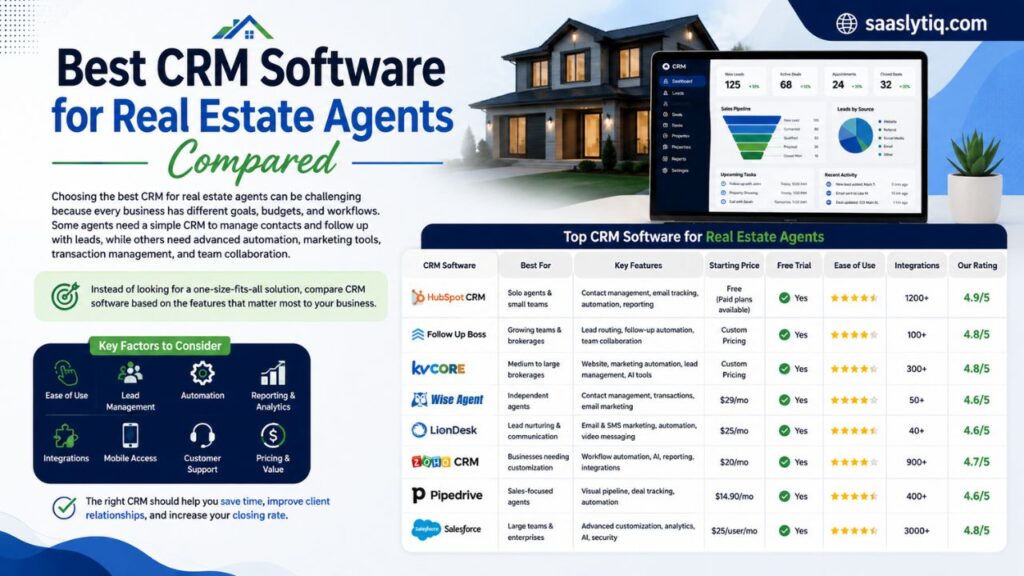
The comparison below highlights some of the most trusted CRM platforms used by real estate professionals around the world.
Comparison Table of the Best CRM for Real Estate Agents
| CRM Software | Best For | Free Plan | AI Features | Starting Price | Overall Rating |
| HubSpot CRM | Solo agents and small teams | Yes | Yes | Free (Paid plans available) | 4.9/5 |
| Follow Up Boss | Real estate teams | No | Yes | Custom Pricing | 4.8/5 |
| Wise Agent | Independent agents | No | Limited | Affordable | 4.7/5 |
| kvCORE | Large brokerages | No | Yes | Custom Pricing | 4.8/5 |
| LionDesk | Lead nurturing | No | Basic | Affordable | 4.6/5 |
| Zoho CRM | Growing businesses | Yes | Yes | Affordable | 4.8/5 |
| Pipedrive | Sales pipeline management | Yes | Yes | Affordable | 4.7/5 |
| Salesforce | Enterprise agencies | No | Advanced | Premium | 4.8/5 |
Let’s take a closer look at each platform.
1. HubSpot CRM
Best for: Solo real estate agents, startups, and small agencies.
HubSpot CRM is one of the most popular CRM solutions because it offers an excellent free plan and a user-friendly interface. It combines contact management, deal tracking, email marketing, meeting scheduling, reporting, and automation in one platform. As your business grows, you can upgrade to paid plans without changing systems.
Key Features
- Contact management
- Sales pipeline
- Email tracking
- Marketing automation
- Live chat
- AI-powered content tools
- Reporting dashboard
- Mobile application
Pros
- Free plan available
- Easy to use
- Excellent marketing features
- Strong automation
- Large integration marketplace
Cons
- Advanced automation requires paid plans.
- Premium features become more expensive as your business grows.
Ideal For
Agents looking for an easy-to-use CRM that can scale with their business.
2. Follow Up Boss
Best for: High-performing real estate teams and growing brokerages.
Follow Up Boss is designed specifically for the real estate industry. It helps teams capture leads from multiple sources, automate follow-ups, distribute inquiries among agents, and improve lead conversion.
Key Features
- Lead routing
- Automated follow-ups
- Team collaboration
- Smart sales pipeline
- Email and SMS communication
- Reporting tools
- Mobile access
Pros
- Built for real estate
- Excellent lead management
- Powerful automation
- Strong customer support
Cons
- No free version.
- Higher monthly cost than many competitors.
Ideal For
Real estate businesses that receive a large number of online leads.
3. Wise Agent
Best for: Independent agents and small real estate businesses.
Wise Agent focuses on helping agents stay organized through contact management, transaction tracking, and marketing tools. It is affordable and simple to use, making it a popular choice for professionals who want industry-specific features without unnecessary complexity.
Key Features
- Contact management
- Transaction tracking
- Email marketing
- Calendar integration
- Task reminders
- Document storage
Pros
- Affordable pricing
- Easy interface
- Real estate-focused features
- Reliable customer support
Cons
- Limited AI functionality.
- Interface could be more modern.
Ideal For
Agents looking for a budget-friendly CRM designed specifically for real estate.
4. kvCORE
Best for: Medium and large brokerages.
kvCORE combines CRM software, lead generation, marketing automation, website management, and AI-powered tools into one complete platform. It is designed for agencies that want to manage their entire sales and marketing process from a single system.
Key Features
- Smart CRM
- Lead generation
- Property website
- Marketing automation
- AI assistant
- Reporting dashboard
- Listing management
Pros
- Comprehensive feature set
- Excellent automation
- Strong AI capabilities
- Built specifically for real estate
Cons
- Custom pricing
- Learning curve for beginners
Ideal For
Brokerages that need an all-in-one business management platform.
5. LionDesk
Best for: Lead nurturing and client communication.
LionDesk is well known for its communication features, including email, text messaging, and video messaging. It helps agents maintain regular contact with prospects throughout the buying journey.
Key Features
- Contact management
- Email marketing
- SMS campaigns
- Video messaging
- Automation
- Pipeline tracking
Pros
- Affordable
- Excellent communication tools
- Easy to learn
- Good automation
Cons
- Limited advanced reporting.
- Smaller integration ecosystem.
Ideal For
Agents who prioritize client communication and relationship building.
6. Zoho CRM
Best for: Agencies that need flexibility and customization.
Zoho CRM offers advanced customization options that allow businesses to build workflows based on their specific sales process. It also includes artificial intelligence, automation, reporting, and a large collection of business applications.
Key Features
- Workflow automation
- AI sales assistant
- Email marketing
- Custom dashboards
- Sales forecasting
- Mobile CRM
- Third-party integrations
Pros
- Affordable pricing
- Highly customizable
- Powerful automation
- Large ecosystem of business apps
Cons
- Initial setup can take time.
- Some advanced features require premium plans.
Ideal For
Growing real estate businesses that want maximum flexibility.
7. Pipedrive
Best for: Sales-focused real estate professionals.
Pipedrive is built around visual pipeline management. It makes it easy to organize leads, monitor deals, and automate sales activities.
Key Features
- Visual sales pipeline
- Workflow automation
- Email integration
- Activity reminders
- Reporting dashboard
- AI-powered recommendations
Pros
- Clean interface
- Easy setup
- Excellent pipeline management
- Strong automation
Cons
- Limited marketing features.
- Fewer real estate-specific tools.
Ideal For
Agents focused on improving sales performance and deal tracking.
8. Salesforce
Best for: Enterprise real estate companies and franchise organizations.
Salesforce is one of the most advanced CRM platforms available today. It offers powerful automation, artificial intelligence, advanced reporting, and unlimited customization. While it requires more setup than most competitors, it is ideal for large organizations with complex business processes.
Key Features
- Enterprise CRM
- AI-powered analytics
- Workflow automation
- Sales forecasting
- Advanced reporting
- Custom application development
- Large integration marketplace
Pros
- Extremely powerful
- Highly scalable
- Excellent reporting
- Enterprise-level security
Cons
- Higher cost.
- Steeper learning curve.
- Requires implementation planning.
Ideal For
Large brokerages and enterprises with multiple offices and complex sales operations.
Which Real Estate CRM Should You Choose?
There is no single CRM that is perfect for every real estate business. The best choice depends on your budget, business size, and daily workflow.
- Choose HubSpot CRM if you want a beginner-friendly platform with an excellent free plan.
- Choose Follow Up Boss if your team manages a high volume of real estate leads.
- Choose Wise Agent if you need an affordable CRM built specifically for real estate professionals.
- Choose kvCORE if you want an all-in-one solution for lead generation, marketing, and brokerage management.
- Choose LionDesk if communication and lead nurturing are your top priorities.
- Choose Zoho CRM if you need advanced customization and workflow automation.
- Choose Pipedrive if your main goal is improving sales pipeline management.
- Choose Salesforce if you manage a large real estate organization that requires enterprise-level scalability.
The best CRM for real estate agents is the one that fits your business today while giving you the flexibility to grow in the future. Before making your final decision, compare features, test free trials, and evaluate how each platform supports your sales process. A well-chosen CRM can improve productivity, strengthen client relationships, and help you close more property deals year after year.
How to Choose the Best CRM for Real Estate Agents
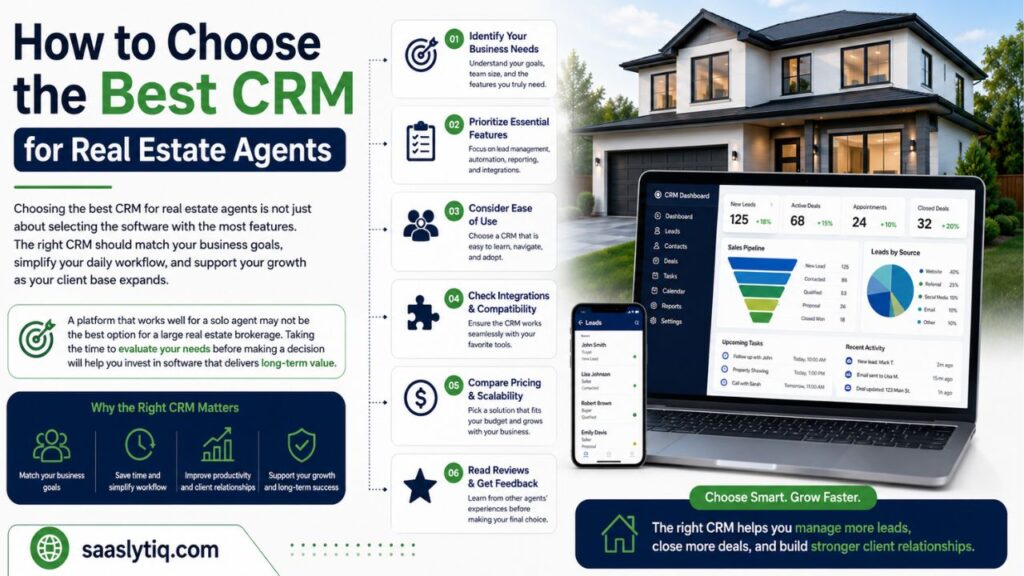
Choosing the best CRM for real estate agents is not just about selecting the software with the most features. The right CRM should match your business goals, simplify your daily workflow, and support your growth as your client base expands. A platform that works well for a solo agent may not be the best option for a large real estate brokerage. Taking the time to evaluate your needs before making a decision will help you invest in software that delivers long-term value.
Identify Your Business Needs
Start by understanding how your real estate business operates. Think about the number of leads you receive each month, how many agents will use the CRM, and which tasks consume most of your time.
Ask yourself these questions:
- Do you work alone or with a team?
- How many leads do you manage each month?
- Do you need marketing automation?
- Do you want built-in email and SMS tools?
- Do you need transaction management?
- Will you use the CRM on mobile devices?
Your answers will help you narrow down the platforms that best fit your workflow.
Consider Ease of Use
A powerful CRM is only useful if your team enjoys using it. A complicated interface can slow down productivity and reduce adoption among employees.
Choose software with:
- A clean dashboard
- Simple navigation
- Easy contact management
- Quick report generation
- Minimal learning curve
Many CRM providers offer free trials or live demos, giving you the opportunity to test the platform before committing to a subscription.
Check Integration Options
Your CRM should work seamlessly with the business tools you already use. Strong integrations reduce manual work and help keep your data accurate.
Useful integrations include:
- Google Workspace
- Microsoft Outlook
- Gmail
- Google Calendar
- DocuSign
- MLS platforms
- Accounting software
- Email marketing tools
The more connected your systems are, the more efficient your daily workflow becomes.
Compare Pricing and Scalability
Price is important, but it should not be the only factor in your decision. A low-cost CRM that lacks essential features may cost more in lost productivity over time.
Compare:
- Monthly and annual pricing
- Cost per user
- Storage limits
- Automation features
- Upgrade options
- Customer support
Also consider whether the CRM can grow with your business. Choosing scalable software now can save you the time and expense of switching platforms later.
Read Customer Reviews
Before making a final decision, research what other real estate professionals say about the software. Customer reviews often highlight real-world advantages and limitations that may not appear on the provider’s website.
Pay close attention to feedback about:
- Ease of use
- Customer support
- Reliability
- Performance
- Updates
- Overall satisfaction
Learning from other users’ experiences can help you make a more informed choice.
Make Your Final Decision
The best CRM for real estate agents is the one that helps you stay organized, respond to leads quickly, automate repetitive tasks, and build stronger relationships with buyers and sellers. Instead of choosing software based only on popularity or price, evaluate how well it supports your business goals today and how easily it can adapt as your real estate business grows. A well-chosen CRM will become an essential tool that improves efficiency, increases productivity, and helps you close more property deals year after year.
Frequently Asked Questions (FAQs)
1. What is the best CRM for real estate agents?
The best CRM for real estate agents depends on your business size, budget, and specific requirements. HubSpot CRM is an excellent option for beginners and small agencies because it offers a free plan and an easy-to-use interface. Follow Up Boss is ideal for real estate teams that need advanced lead management, while kvCORE is better suited for larger brokerages looking for an all-in-one real estate platform.
2. Why do real estate agents need a CRM?
A CRM helps real estate agents organize leads, manage client relationships, automate follow-ups, schedule appointments, store important documents, and track every stage of the sales pipeline. It improves productivity, reduces manual work, and increases the chances of closing more property deals.
3. Can a CRM help generate more real estate leads?
A CRM itself does not generate leads, but it helps capture and manage leads from websites, property portals, social media, referrals, and online advertising. It also automates follow-ups and lead nurturing, helping convert more prospects into clients.
4. What features should I look for in a real estate CRM?
Look for features such as lead management, contact management, sales pipeline tracking, email marketing, workflow automation, appointment scheduling, document management, mobile access, reporting, AI-powered tools, and integrations with MLS platforms and third-party business applications.
5. Is there a free CRM for real estate agents?
Yes. Several CRM providers offer free plans with essential features. HubSpot CRM is one of the most popular free CRM solutions for real estate professionals. However, advanced automation, reporting, and team collaboration tools are usually available only in paid plans.
6. How much does a real estate CRM cost?
The cost varies depending on the provider and features. Basic plans usually start at $15–$30 per user per month, while professional plans range from $50–$100 per user per month. Enterprise solutions for large brokerages may cost significantly more and often include custom pricing.
7. Can a real estate CRM integrate with other software?
Yes. Most modern CRM platforms integrate with Google Workspace, Microsoft Outlook, Gmail, Google Calendar, DocuSign, MLS systems, accounting software, email marketing platforms, and many other business tools to improve workflow and productivity.
8. Which CRM is best for a solo real estate agent?
Solo agents often prefer HubSpot CRM, Wise Agent, or Zoho CRM because they are affordable, easy to use, and include essential features like lead management, contact organization, and automation.
9. Is AI important in a real estate CRM?
Yes. AI-powered CRM software can score leads, predict customer behavior, automate repetitive tasks, suggest follow-up actions, generate emails, and provide valuable sales insights. These features help agents save time and improve efficiency.
10. How do I choose the right CRM for my real estate business?
Start by identifying your business needs, budget, team size, and future growth plans. Compare features, pricing, integrations, ease of use, customer support, and scalability. Taking advantage of free trials or live demonstrations can also help you make an informed decision.
Conclusion
Finding the best CRM for real estate agents is one of the most important decisions you can make for your business. The right CRM helps you organize leads, manage client relationships, automate daily tasks, and track every stage of the property sales process from the first inquiry to the final closing. Instead of spending time on manual work, you can focus on building relationships, serving clients, and growing your real estate business.
Every CRM platform offers different strengths, so take the time to compare features, pricing, integrations, and ease of use before making your decision. Whether you’re a solo real estate agent, a growing agency, or a large brokerage, choosing software that fits your workflow will improve productivity and help you close more deals.
At SaaSlytiq, our goal is to help you make informed software decisions through expert reviews, detailed comparisons, and practical buying guides. Explore our other CRM resources to discover the best solutions for different industries and find the software that supports your long-term business success.