

CRM stock represents Salesforce, Inc., one of the largest companies in the customer relationship management (CRM) software market. Salesforce provides cloud-based tools that help businesses manage sales, customer service, marketing, data, and other business operations. The company trades on the New York Stock Exchange under the ticker symbol CRM.
Investors follow CRM stock because Salesforce continues to expand beyond traditional CRM software. Its focus on artificial intelligence, data services, and Agentforce has become an important part of its growth strategy. At the same time, investors watch revenue growth, earnings, free cash flow, valuation, and competition in the enterprise software market.
This guide looks at CRM stock from several angles. We will cover Salesforce’s stock price and key financial metrics, recent business performance, AI and Agentforce developments, analyst price targets, valuation, dividends, and major risks. Since stock prices and analyst estimates can change, current market figures should always be checked before making an investment decision.
What Is CRM Stock?
CRM stock is the publicly traded stock of Salesforce, Inc., a major enterprise software company. Salesforce trades on the New York Stock Exchange (NYSE) under the ticker symbol CRM. The company is best known for its customer relationship management software, which helps businesses manage sales, customer service, marketing, customer data, and other business processes.
Salesforce has expanded beyond traditional CRM software. Its platform now includes products such as Sales Cloud, Service Cloud, Data Cloud, Slack, Tableau, MuleSoft, and Agentforce. Artificial intelligence has also become an important part of the company’s strategy. Agentforce is designed to help businesses use AI agents within their workflows, while Salesforce continues to develop its broader data and AI platform. Recent market coverage has highlighted Agentforce, Data 360, and Salesforce’s AI partnerships as important areas for investors watching CRM stock.
For investors researching Salesforce stock, it is important to look beyond the ticker symbol and stock price. Revenue growth, earnings per share (EPS), free cash flow, operating margins, customer demand, AI adoption, and valuation can all affect how the market views CRM stock. Salesforce also provides financial information, quarterly results, and SEC filings through its investor relations website, which can help readers verify the company’s latest reported figures.
CRM Stock at a Glance
| Metric | Details |
| Company | Salesforce, Inc. |
| Stock Ticker | CRM |
| Exchange | New York Stock Exchange (NYSE) |
| Industry | Enterprise Software |
| Main Business | Customer Relationship Management |
| Key Areas | CRM, Cloud Software, Data and AI |
| AI Platform | Agentforce |
These details make CRM stock different from the general term “CRM software.” In this article, CRM stock refers specifically to Salesforce shares and the factors that can influence their market value.
CRM Stock Price and Key Market Data
The CRM stock price changes throughout the trading day as investors react to company results, market conditions, analyst expectations, and developments in the software industry. Salesforce shares trade on the New York Stock Exchange under the ticker CRM. When researching Salesforce stock, investors commonly look at the current share price along with the 52-week range, market capitalization, earnings per share (EPS), and valuation ratios.
CRM stock reached a 52-week range of $146.32 to $269.11 as of the September 15, 2026 market close. The stock closed at $255.65 on that date. These figures provide a recent reference point, but the share price can change each trading day.
Another important measure is Salesforce’s market capitalization, which shows the total market value of the company’s outstanding shares. Investors also monitor the P/E ratio and forward P/E ratio to understand how the market values Salesforce relative to its earnings. These measures become more useful when viewed alongside revenue growth, EPS, free cash flow, and other company fundamentals.
Because stock data changes frequently, readers should check the latest market data before using any CRM stock price or valuation figure for an investment decision. Historical prices and current metrics can also tell different stories, so it is useful to consider both short-term price movement and Salesforce’s longer-term financial performance.
Salesforce Financial Performance
Salesforce’s financial performance is an important factor when analyzing CRM stock. Revenue growth, earnings, operating margins, and cash flow can give investors a clearer picture of the company’s underlying business. Since Salesforce earns most of its revenue from subscription-based software and services, investors also watch its remaining performance obligations, which can provide insight into future contracted revenue.
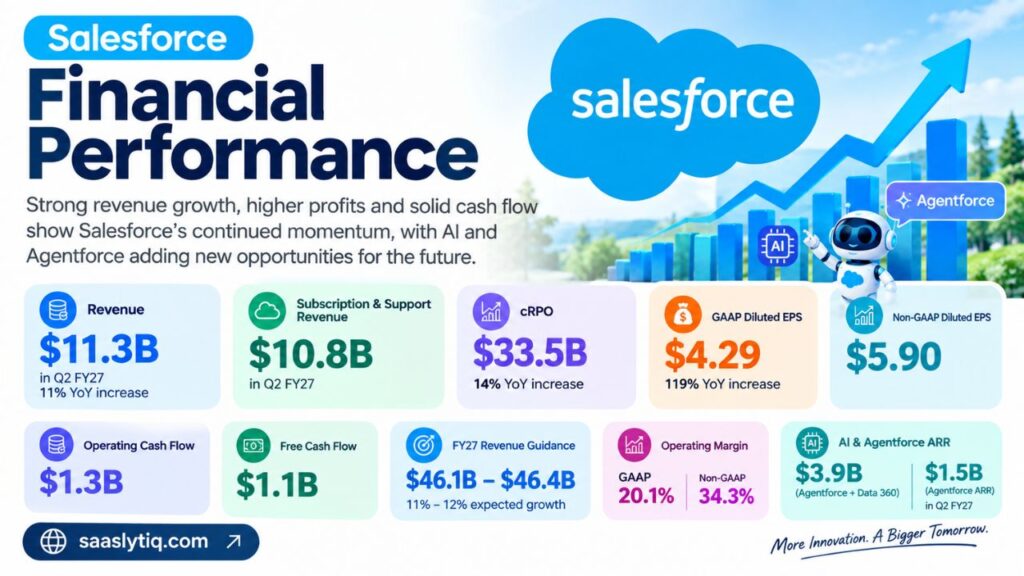
In its second quarter of fiscal 2027, Salesforce reported $11.3 billion in revenue, an 11% year-over-year increase. Subscription and support revenue reached $10.8 billion, while current remaining performance obligations (cRPO) rose 14% year over year to $33.5 billion. These results show that Salesforce continued to generate growth from its core cloud software business.
Profitability also improved during the quarter. Salesforce reported GAAP diluted earnings per share of $4.29, up 119% from the same quarter a year earlier. Non-GAAP diluted EPS reached $5.90. The company also generated $1.3 billion in operating cash flow and $1.1 billion in free cash flow during the quarter. Strong cash generation is important because it gives Salesforce flexibility to invest in its products, return capital to shareholders, and pursue strategic opportunities.
Salesforce also raised its full-year fiscal 2027 revenue guidance to $46.1 billion to $46.4 billion, representing expected growth of 11% to 12%. The company expects full-year GAAP operating margin of 20.1% and non-GAAP operating margin of 34.3%. These figures are useful when evaluating the future growth and profitability of Salesforce stock, although actual results can differ from company guidance.
The company’s recent results also show why AI and Agentforce have become important to the CRM stock story. Salesforce said Agentforce and Data 360 annual recurring revenue reached nearly $3.9 billion in Q2 FY27, while Agentforce ARR exceeded $1.5 billion. This gives investors another area to monitor as Salesforce attempts to turn AI adoption into additional recurring revenue.
What Is Driving CRM Stock?
Several factors can influence the performance of CRM stock, but Salesforce’s growth in artificial intelligence has become an important part of the company’s current strategy. Salesforce is expanding its traditional CRM platform with AI agents, unified data, and automation. Its Agentforce platform is designed to help businesses use AI agents for tasks such as customer service, sales support, and business workflows.
Artificial Intelligence and Agentforce
AI could create another source of growth for Salesforce as businesses look for ways to automate repetitive tasks and improve customer interactions. Agentforce connects AI agents with Salesforce applications and business data. This allows companies to use AI within existing CRM workflows instead of treating it as a separate tool. Salesforce has also positioned Agentforce alongside its broader Customer 360 platform and Data Cloud strategy.
Data Cloud and Customer Data
Data is another important part of Salesforce’s AI strategy. AI systems need access to useful and organized business data to provide relevant results. Data Cloud helps businesses bring customer information together across different sources. This can support personalization, analytics, automation, and AI-powered workflows. For CRM stock investors, the growth of Salesforce’s data business is worth watching because it can increase the value of the company’s wider software ecosystem.
Enterprise Software Demand
Salesforce also benefits from demand for cloud-based enterprise software. Businesses use its products for sales management, customer service, marketing, analytics, collaboration, and data management. Products such as Sales Cloud, Service Cloud, Slack, Tableau, MuleSoft, and Data Cloud allow Salesforce to serve multiple business functions through one broader ecosystem.
Competition and AI Adoption
Competition remains an important factor. Salesforce competes with large technology companies and specialized software providers across different parts of the enterprise software market. The pace at which businesses adopt AI, their willingness to spend on new software, and Salesforce’s ability to turn AI usage into recurring revenue could all affect future Salesforce stock performance.
For investors researching CRM stock analysis, the key issue is not simply whether Salesforce has AI products. It is whether Agentforce, Data Cloud, and other AI offerings can generate sustainable revenue growth while maintaining strong margins and cash flow.
| Key Driver | Why It Matters for CRM Stock |
| Agentforce | Could create new AI-related revenue opportunities for Salesforce |
| Data Cloud | Helps businesses connect customer data and supports AI-powered workflows |
| Enterprise Software Demand | Strong demand can support Salesforce’s cloud software revenue |
| AI Adoption | Higher customer adoption could support future growth |
| Competition | Microsoft, Oracle, SAP, ServiceNow, and other providers can affect market share |
| Revenue Growth | Shows whether Salesforce is continuing to expand its business |
| Profit Margins | Indicates how efficiently Salesforce converts revenue into profit |
| Free Cash Flow | Shows the company’s ability to generate cash and fund investments or shareholder returns |
| AI Monetization | Determines whether Salesforce can turn AI adoption into sustainable recurring revenue |
CRM Stock Forecast and Price Targets
The CRM stock forecast depends on several factors, including Salesforce’s revenue growth, earnings, free cash flow, AI adoption, valuation, and broader demand for enterprise software. Analysts use these factors to develop 12-month price targets, but those targets are estimates rather than guaranteed future prices. They can change after earnings reports, company announcements, or major changes in market conditions.
As of September 2026, analyst estimates for Salesforce show a wide range of expectations. StockAnalysis reports an average 12-month price target of $273.37 from 56 analysts, with individual targets ranging from $160 to $475. MarketBeat reports an average target of $267.13 based on 48 analysts. The differences show why investors should look at the underlying assumptions instead of relying on a single CRM stock price target.
Recent analyst updates also show how quickly expectations can change. For example, UBS set a $240 target on September 11, while Morgan Stanley set a $315 target and Needham maintained a $400 target on September 2. Other firms have issued targets between these levels.
When researching a Salesforce stock forecast, investors should therefore pay attention to the company’s actual business performance. Revenue growth, cRPO, Agentforce adoption, Data Cloud growth, operating margins, and free cash flow can provide more useful context than a price target alone. Salesforce’s recent AI developments have also become an important part of the market discussion around CRM stock.
| Factor | Why It Matters for CRM Stock |
| Revenue growth | Shows demand for Salesforce products |
| EPS growth | Indicates changes in profitability |
| Agentforce adoption | Measures progress in Salesforce’s AI strategy |
| cRPO growth | Provides insight into future contracted revenue |
| Free cash flow | Shows the company’s ability to generate cash |
| Valuation | Helps investors assess the price relative to earnings |
| Analyst estimates | Shows the range of current market expectations |
A forecast should always be treated as an estimate. CRM stock can move differently from analyst expectations because market sentiment, interest rates, technology trends, earnings results, and unexpected company developments can all affect the share price.
CRM Stock Valuation
Valuation is another important part of CRM stock analysis. It helps investors compare Salesforce’s share price with the company’s earnings and cash-generating ability. Common measures include the price-to-earnings (P/E) ratio, forward P/E ratio, price-to-free-cash-flow ratio, and market capitalization.
Salesforce is a mature enterprise software company, so investors often compare its valuation with other large technology and SaaS companies. Companies such as Microsoft, Oracle, SAP, ServiceNow, Adobe, and HubSpot operate in related areas, although their business models and growth rates are not identical. A comparison can provide useful context, but each company should be evaluated based on its own financial results.
The P/E ratio is particularly useful when analyzing Salesforce stock. It compares the company’s share price with its earnings per share. A lower P/E can indicate that investors are paying less for each dollar of earnings, while a higher P/E can reflect stronger growth expectations or other factors. However, P/E should not be considered on its own.
Investors should also examine Salesforce’s free cash flow and operating margins. Strong cash generation can support dividends, share repurchases, debt management, and investment in areas such as artificial intelligence. At the same time, sustained margin expansion can improve profitability even when revenue growth moderates.
Salesforce’s AI strategy also affects how investors view its valuation. Agentforce, Data Cloud, and other AI products could create additional revenue opportunities, but the market will continue to watch whether these products produce meaningful and sustainable financial growth. Therefore, a complete CRM stock valuation should consider the company’s current earnings as well as its future growth potential and the risks surrounding that growth.
CRM Stock Risks to Watch
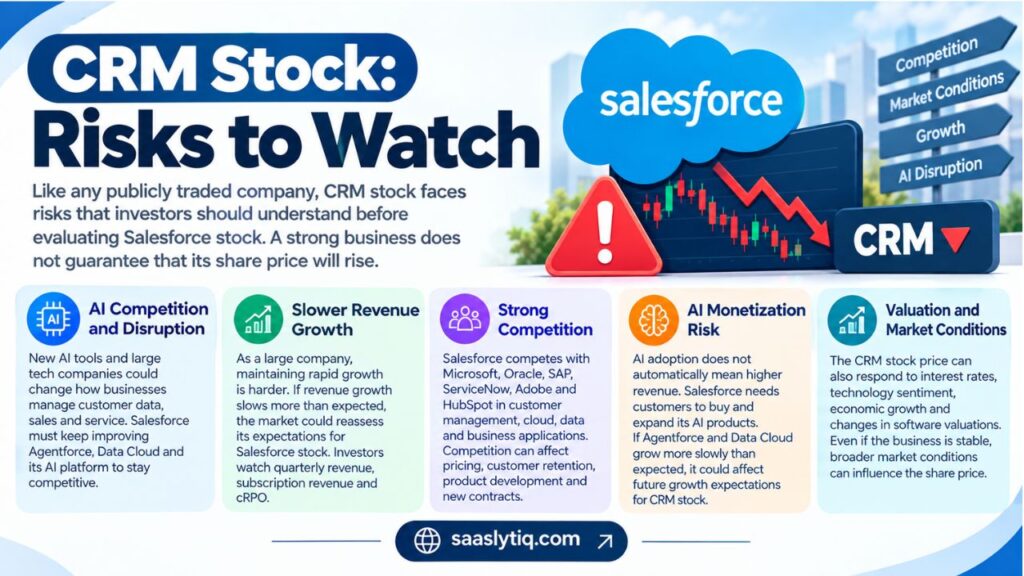
Like any publicly traded company, CRM stock faces risks that investors should understand before evaluating Salesforce stock. A strong business does not guarantee that its share price will rise. Changes in earnings expectations, competition, economic conditions, or investor sentiment can all affect Salesforce’s market value.
AI Competition and Disruption
Artificial intelligence creates an opportunity for Salesforce, but it also creates competitive pressure. New AI tools could change how businesses manage customer data, sales, and customer service. Salesforce must continue improving Agentforce, Data Cloud, and its broader AI platform to remain competitive. Large technology companies and specialized AI providers are also developing products that could compete for enterprise spending.
Slower Revenue Growth
Salesforce has grown into a very large enterprise software company. Maintaining rapid growth becomes more difficult as a company gets larger. If revenue growth slows more than investors expect, the market could reassess its expectations for Salesforce stock. Investors therefore watch quarterly revenue, subscription and support revenue, and current remaining performance obligations (cRPO).
Strong Competition
Salesforce operates in a highly competitive software market. Companies such as Microsoft, Oracle, SAP, ServiceNow, Adobe, and HubSpot compete with Salesforce in different areas of customer management, cloud software, data, analytics, and business applications. Competition can affect pricing, customer retention, product development, and Salesforce’s ability to win new contracts.
AI Monetization Risk
AI adoption does not automatically translate into higher revenue. Salesforce needs customers to purchase and expand its AI products. Investors will continue watching whether Agentforce and Data Cloud can generate sustainable recurring revenue while maintaining healthy margins. If adoption develops more slowly than expected, it could affect future growth expectations for CRM stock.
Valuation and Market Conditions
The CRM stock price can also respond to broader market conditions. Interest rates, technology-sector sentiment, economic growth, and changes in software valuations can influence the price even when Salesforce’s business performance remains relatively stable. This is why investors should consider both company-specific fundamentals and the wider market environment when analyzing Salesforce stock.
CRM Stock Dividend and Share Buybacks
Salesforce has become more focused on returning capital to shareholders as its business generates substantial cash. The company pays a quarterly dividend and also uses share repurchases as part of its capital allocation strategy. These two methods can be relevant when evaluating the overall return potential of CRM stock.
Salesforce initiated its first quarterly cash dividend in 2024. The company has continued making dividend payments while maintaining investment in its cloud software, data, and artificial intelligence businesses. Because Salesforce generates significant operating cash flow, investors can evaluate the dividend alongside free cash flow and the company’s broader capital allocation plans.
Share repurchases are another important part of Salesforce’s strategy. When a company buys back its own shares, it reduces the number of shares outstanding. If earnings remain stable or increase, fewer outstanding shares can contribute to higher earnings per share. However, the effect of buybacks depends on the price paid for those shares and the company’s other uses of cash.
For CRM stock investors, dividends and buybacks should therefore be viewed together with revenue growth, profitability, free cash flow, and valuation. A dividend alone does not determine whether Salesforce stock is attractive, but consistent cash generation gives the company flexibility to return capital while continuing to invest in future growth areas such as Agentforce and Data Cloud.
What Investors Should Watch in CRM Stock
When analyzing CRM stock, investors should look beyond the daily Salesforce stock price. Quarterly financial results can provide a clearer picture of whether the company’s business is growing and how efficiently it is operating. Revenue, earnings per share, operating margins, and free cash flow are some of the key figures to monitor.
Agentforce and Data Cloud are also important areas to watch. Salesforce is investing heavily in artificial intelligence and wants AI-powered products to become a meaningful part of its recurring revenue. Investors can follow customer adoption, annual recurring revenue, and the company’s commentary about AI demand in future earnings reports.
Another important metric is current remaining performance obligations (cRPO). This represents contracted revenue that Salesforce expects to recognize over the coming period. Changes in cRPO can provide useful information about future subscription revenue and customer demand.
Investors should also monitor Salesforce’s competitive position. Changes in enterprise software spending, competition from Microsoft, Oracle, SAP, ServiceNow, and other technology companies can affect future growth. At the same time, the company’s operating margin and free cash flow can show whether Salesforce is converting its revenue growth into stronger profitability.
Finally, CRM stock valuation deserves regular attention. A company’s financial performance can improve while its stock price also becomes more expensive relative to earnings. Looking at valuation alongside revenue growth, EPS, cash flow, AI adoption, and business risks provides a more complete view of Salesforce stock.
CRM Stock FAQs
What does CRM stock represent?
CRM stock represents Salesforce, Inc. Salesforce is a cloud-based enterprise software company best known for customer relationship management (CRM) solutions. Its shares trade on the New York Stock Exchange under the ticker symbol CRM.
What is Salesforce known for?
Salesforce provides software for sales, customer service, marketing, data management, analytics, and collaboration. Its major products include Sales Cloud, Service Cloud, Slack, Tableau, MuleSoft, Data Cloud, and Agentforce.
What affects the CRM stock price?
Several factors can affect the CRM stock price. These include Salesforce’s revenue growth, earnings, free cash flow, AI adoption, customer demand, analyst expectations, competition, interest rates, and overall technology-sector conditions.
Does Salesforce pay a dividend?
Yes. Salesforce began paying a quarterly cash dividend in 2024. Investors should check Salesforce’s latest investor-relations information for the current dividend amount and payment schedule because dividend policies can change.
What is the CRM stock forecast?
A CRM stock forecast represents an estimate of where analysts think Salesforce shares could trade in the future. Analysts use financial performance, growth expectations, valuation, and market conditions when setting price targets. These estimates can change and should not be treated as guaranteed future prices.
What is Agentforce?
Agentforce is Salesforce’s platform for AI agents. It is designed to help businesses automate tasks and workflows using artificial intelligence while working with Salesforce applications and business data. Agentforce has become an important part of Salesforce’s AI growth strategy.
Is Salesforce still growing?
Salesforce continues to generate revenue growth, although its growth rate is important to monitor as the company becomes larger. Recent financial results showed continued growth in revenue and current remaining performance obligations, while AI products have become an additional area of expansion.
When does Salesforce report earnings?
Salesforce reports financial results on a quarterly basis. Investors can find upcoming earnings dates, quarterly results, SEC filings, and other official financial information through Salesforce’s investor relations resources. Checking the latest company announcement is the best way to confirm the next reporting date.
Conclusion
CRM stock gives investors exposure to Salesforce, one of the largest companies in the enterprise software market. The company continues to generate revenue from its core CRM products while expanding into data, cloud services, and artificial intelligence. Recent financial results also show continued growth in revenue, earnings, and cash flow.
The future of Salesforce stock will depend on several factors. Investors will continue to watch revenue growth, profitability, free cash flow, valuation, competition, and the adoption of products such as Agentforce and Data Cloud. Analyst price targets can provide additional market context, but they are estimates and can change as new information becomes available.
For anyone researching CRM stock, it is important to review the latest financial results and market data rather than relying on an older stock price or forecast. Looking at both Salesforce’s growth opportunities and its potential risks can provide a more balanced understanding of the company and its stock.