
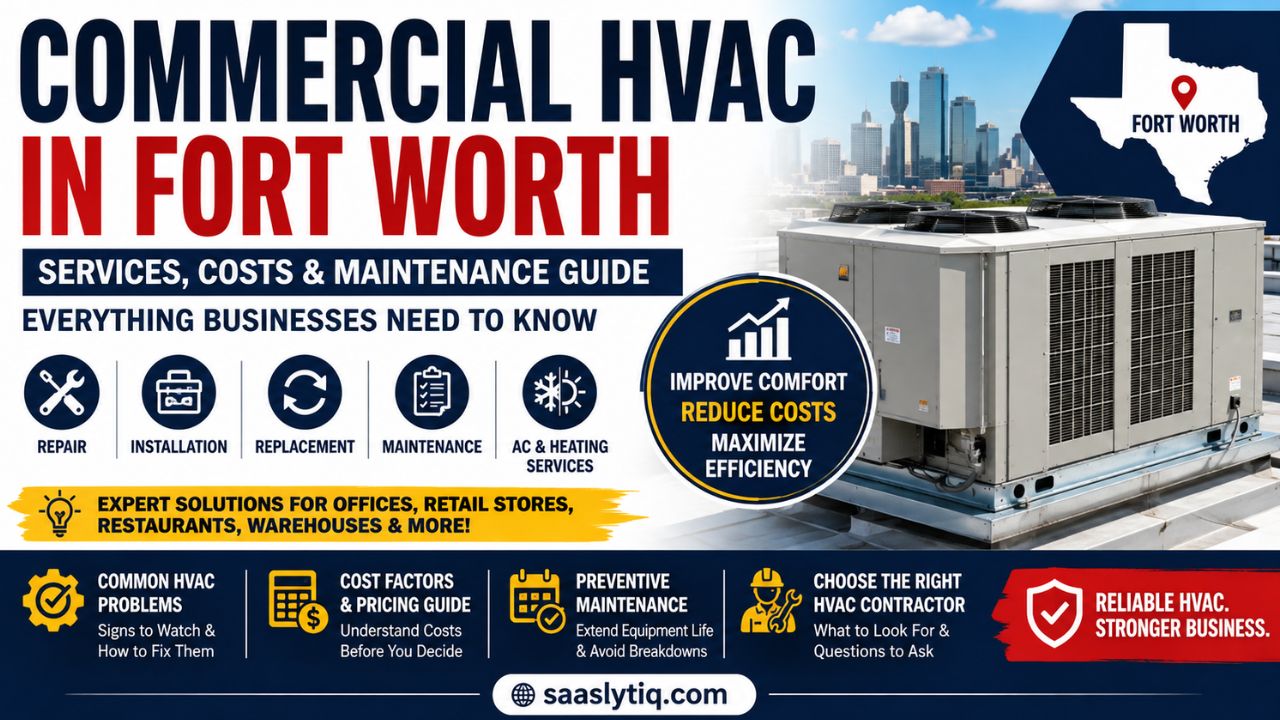
For businesses in Fort Worth, a reliable HVAC system is more than just a comfort feature—it plays an important role in keeping daily operations running smoothly. From offices and retail stores to restaurants, warehouses, and large commercial facilities, a properly working heating and cooling system helps maintain a comfortable environment for employees, customers, and visitors. With Fort Worth’s hot summers and changing temperatures throughout the year, commercial HVAC systems often work hard to keep indoor spaces at the right temperature.
When a commercial HVAC system starts struggling, the problem can quickly become more than an inconvenience. Poor airflow, uneven temperatures, unusual noises, rising energy bills, or unexpected breakdowns can affect productivity and lead to costly downtime. That’s why businesses need dependable commercial HVAC services for regular maintenance, timely repairs, system installation, and replacement when necessary.
In this guide, we’ll cover everything businesses should know about commercial HVAC in Fort Worth, including common HVAC services, commercial system types, maintenance needs, cost factors, warning signs, and tips for choosing the right HVAC contractor for your building.
What Is Commercial HVAC?
Commercial HVAC refers to the heating, ventilation, and air conditioning systems used in business and commercial buildings. These systems are designed to handle larger spaces, higher occupancy levels, and more demanding heating and cooling requirements than typical residential HVAC systems. Depending on the building, a commercial system may include rooftop units, packaged systems, commercial split systems, chillers, boilers, air handlers, and advanced temperature controls.
Unlike residential HVAC, commercial systems often need to manage different areas of a building at the same time. For example, an office may need comfortable temperatures in employee workspaces while meeting rooms, storage areas, and server rooms have different requirements. Proper zoning, airflow, ventilation, and temperature control can make a significant difference in both comfort and energy use.
Commercial HVAC vs. Residential HVAC
The main difference is the size and complexity of the system. Commercial HVAC equipment is generally built to handle larger cooling and heating loads and may serve several zones or floors. Commercial buildings also tend to have more complicated ventilation and control requirements.
For Fort Worth businesses, choosing the right commercial HVAC system is important because equipment must be capable of handling the area’s demanding summer temperatures while operating efficiently. Proper installation, regular maintenance, and timely repairs can help keep the system reliable and reduce the risk of unexpected business disruptions.
Commercial HVAC Services in Fort Worth
A commercial HVAC system needs regular attention to keep a business comfortable and operating without unnecessary interruptions. Whether you need a quick repair, a complete system replacement, or routine maintenance, working with an experienced commercial HVAC professional can help identify problems before they turn into larger and more expensive issues.
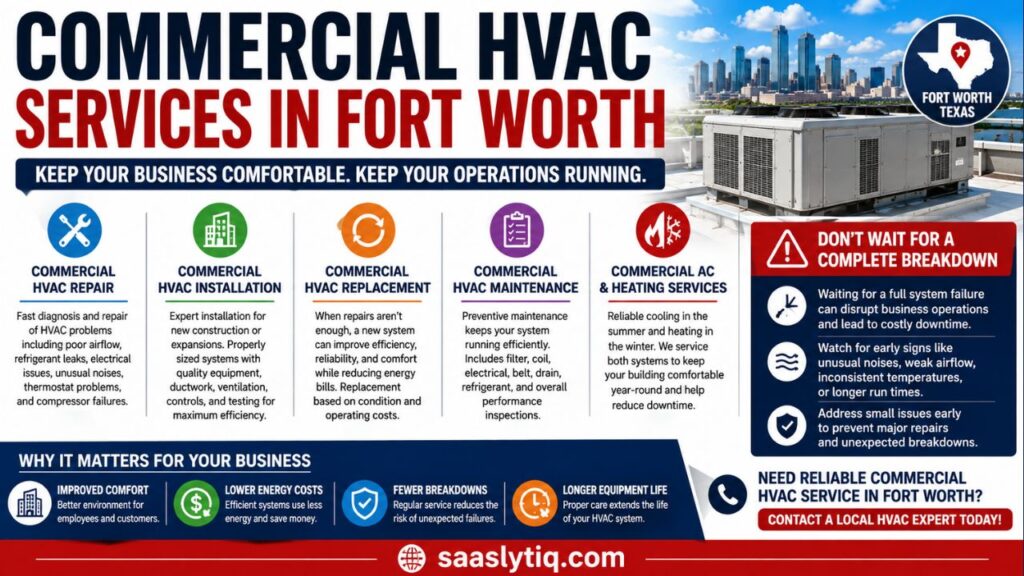
Businesses in Fort Worth may need different HVAC services depending on their building size, equipment, operating hours, and cooling and heating demands. The most common services include repair, installation, replacement, maintenance, and commercial air conditioning and heating.
Commercial HVAC Repair
HVAC problems can happen without warning, especially when equipment is working hard during Fort Worth’s hot summer months. Common issues include poor airflow, uneven temperatures, refrigerant leaks, electrical problems, unusual noises, thermostat issues, and compressor failures.
A professional technician can inspect the system, identify the underlying problem, and recommend the appropriate repair. Addressing problems early can help prevent more serious equipment damage and reduce the chance of an unexpected breakdown that disrupts business operations.
Commercial HVAC Installation
When a business is building a new facility or expanding an existing space, the HVAC system needs to be properly sized and designed for the building. Commercial HVAC installation may involve equipment selection, ductwork, ventilation, controls, electrical connections, and system testing.
A properly installed system can provide more consistent temperatures and better efficiency while reducing unnecessary strain on the equipment.
Commercial HVAC Replacement
Repairing an older system is not always the most practical solution. If a commercial HVAC unit requires frequent repairs, struggles to maintain comfortable temperatures, or causes unusually high energy bills, replacement may be worth considering.
A new system can provide improved efficiency, more reliable performance, and better temperature control. However, replacement should be based on the condition and operating costs of the existing equipment rather than age alone.
Commercial HVAC Maintenance
Preventive maintenance helps businesses find and address small problems before they become major failures. Routine service may include inspecting filters, coils, electrical components, belts, drains, refrigerant levels, controls, and overall system performance.
Regular maintenance is especially important for commercial properties because HVAC equipment may operate for long hours and support large occupied spaces.
Commercial AC and Heating Services
Commercial buildings need dependable cooling during Fort Worth’s hot weather and reliable heating during colder periods. HVAC professionals can service both sides of the system, helping businesses maintain comfortable indoor conditions throughout the year.
Regular inspections and timely service can also help businesses avoid unnecessary downtime and keep their heating and cooling equipment operating efficiently.
Don’t Wait for a Complete HVAC Breakdown
One mistake businesses often make is waiting until the HVAC system completely stops working before calling a technician. For a commercial property, that approach can be risky. A breakdown during business hours may affect employees, customers, inventory, or day-to-day operations, especially when the system is already under heavy demand.
Pay attention to smaller changes in performance, such as unusual noises, weaker airflow, inconsistent temperatures, or a system that seems to run longer than normal. These signs don’t always mean that a major repair is needed, but they are worth investigating before a minor issue develops into a larger problem.
Common Commercial HVAC Problems Businesses Shouldn’t Ignore
Commercial HVAC problems don’t always begin with a complete system failure. A weak airflow issue, unusual noise, or small temperature difference may seem minor at first, but ignoring these signs during Fort Worth’s cooling season can allow a relatively simple problem to become a more expensive repair.
For example, if one area of a commercial building starts feeling warmer than the rest, the issue may not necessarily mean that the entire HVAC system needs to be replaced. Restricted airflow, dirty filters, control problems, or a component that is beginning to fail could be contributing to the problem. Having the system inspected early can help identify the actual cause before it affects more of the building.
For businesses, the better approach is to pay attention to changes in HVAC performance rather than waiting for the equipment to stop working completely. Addressing unusual noises, airflow changes, temperature fluctuations, or repeated cycling early can make repairs easier to manage and reduce the risk of unexpected disruption.
Commercial HVAC Systems in Fort Worth
Commercial buildings can use different types of HVAC systems depending on their size, layout, occupancy, and heating and cooling requirements. A small retail store may need a relatively simple packaged system, while a large office building, warehouse, or industrial facility may require multiple rooftop units, chillers, air handlers, or advanced zoning controls.
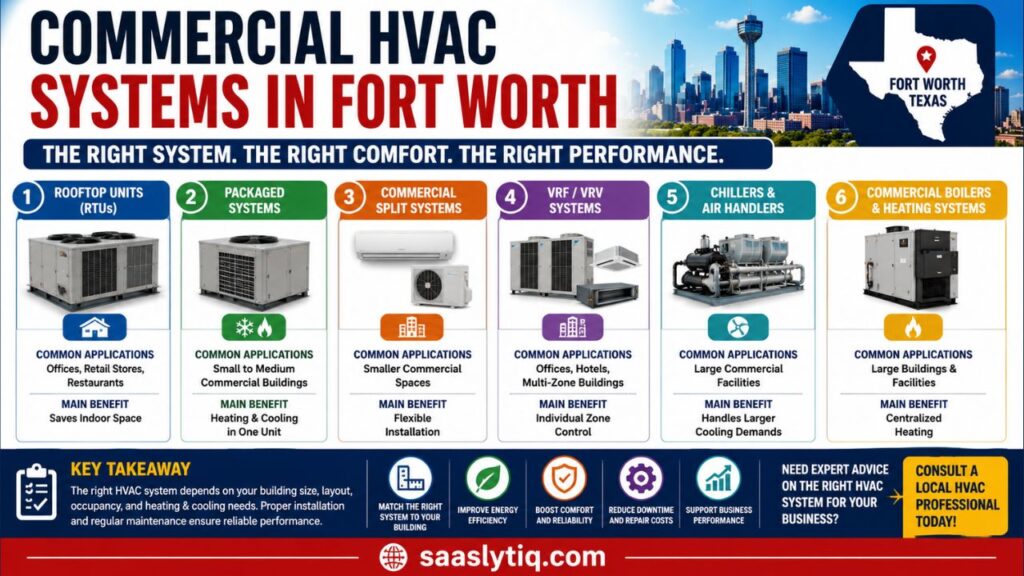
Understanding the type of equipment in your building can make it easier to identify maintenance needs and choose the right service when something goes wrong. A commercial HVAC professional can evaluate the building and recommend equipment based on its cooling load, energy requirements, operating schedule, and available space.
Rooftop HVAC Units (RTUs)
Rooftop units are commonly used in commercial buildings because they save valuable indoor space and can provide heating and cooling through a single packaged system. They are often found on offices, retail buildings, restaurants, and other low-rise commercial properties.
Because rooftop equipment is exposed to outdoor weather throughout the year, regular inspections and maintenance are important. Problems with filters, coils, belts, electrical components, or airflow can affect the system’s performance.
Packaged HVAC Systems
Packaged HVAC systems combine major heating and cooling components into one outdoor unit. They are practical for many commercial buildings because they can simplify installation and maintenance while providing reliable temperature control.
The right packaged system depends on the building’s size and heating and cooling requirements. Proper sizing is important because an oversized or undersized system may not operate efficiently.
Commercial Split Systems
Commercial split systems separate the indoor and outdoor components of the HVAC system. They can be a practical option for smaller commercial spaces or buildings where individual areas need separate temperature control.
Regular maintenance helps keep the indoor and outdoor components working together efficiently and can reduce the risk of unexpected failures.
VRF and VRV Systems
Variable Refrigerant Flow (VRF) and Variable Refrigerant Volume (VRV) systems are designed to provide flexible temperature control across multiple zones. They can allow different areas of a building to be heated or cooled according to individual requirements.
These systems are often useful in buildings where different rooms or zones have different occupancy levels and temperature needs.
Chillers and Air Handlers
Larger commercial buildings may rely on chillers and air-handling units to provide cooling and distribute conditioned air throughout the facility. These systems are more complex than standard packaged units and require specialized service and maintenance.
Regular inspections can help identify issues with pumps, coils, controls, refrigerant systems, airflow, and other components before they cause significant operational problems.
Commercial Boilers and Heating Systems
Some commercial properties use boilers or other centralized heating systems to provide heat throughout the building. These systems require proper inspection, maintenance, and control to operate safely and efficiently.
A qualified commercial HVAC technician can determine whether the heating equipment is performing properly and identify components that may need repair or replacement.
Commercial HVAC System Summary
| HVAC System | Common Applications | Main Benefit |
| Rooftop Units (RTUs) | Offices, retail stores, restaurants | Saves indoor space |
| Packaged Systems | Small to medium commercial buildings | Heating and cooling in one unit |
| Commercial Split Systems | Smaller commercial spaces | Flexible installation |
| VRF/VRV Systems | Offices, hotels, multi-zone buildings | Individual zone control |
| Chillers & Air Handlers | Large commercial facilities | Handles larger cooling demands |
| Commercial Boilers | Large buildings and facilities | Centralized heating |
Choosing the right commercial HVAC system is not simply about selecting the largest or most efficient equipment available. The system should match the building’s size, layout, occupancy, operating schedule, and specific heating and cooling demands. Proper installation and ongoing maintenance are equally important for getting reliable performance from the equipment.
Industries That Need Commercial HVAC in Fort Worth
Almost every type of commercial property depends on a reliable HVAC system. However, the heating and cooling requirements can vary significantly from one industry to another. A restaurant, for example, has very different ventilation and cooling demands than an office building or warehouse.
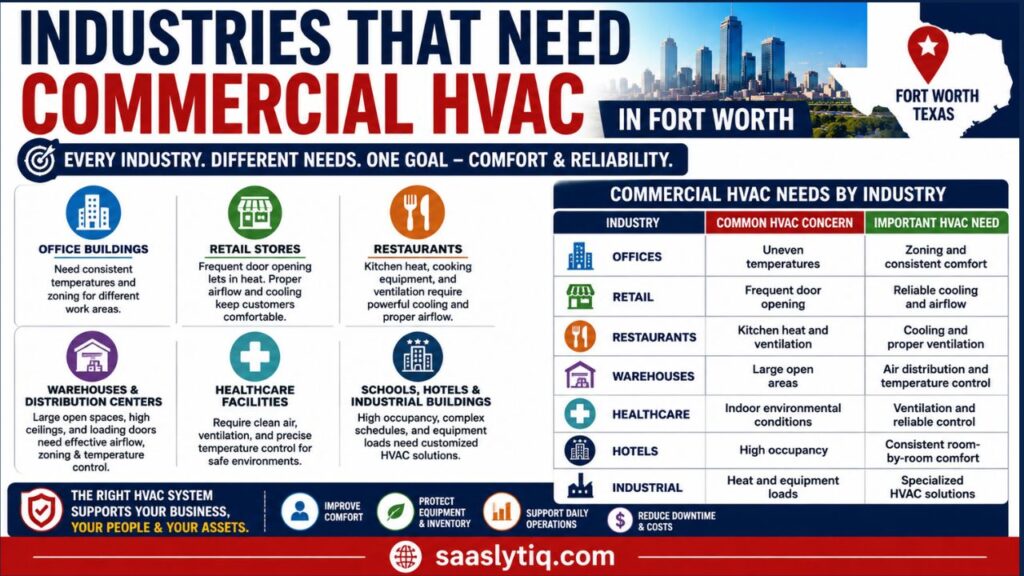
For businesses in Fort Worth, choosing and maintaining the right HVAC system can help create a more comfortable environment while supporting daily operations and protecting equipment, inventory, and other valuable assets.
Office Buildings
Offices need consistent temperatures throughout the workday to keep employees and visitors comfortable. Larger offices may also require multiple zones because meeting rooms, conference areas, workspaces, and common areas can have different occupancy levels.
Retail Stores
Retail stores need a comfortable environment for both customers and employees. Frequent opening of exterior doors can allow outdoor heat to enter the building, increasing the workload on the air conditioning system.
Proper HVAC sizing, airflow, and temperature control can help maintain comfort without placing unnecessary strain on the equipment.
Restaurants
Restaurants often have demanding HVAC requirements because of kitchen heat, cooking equipment, ventilation, and changing occupancy throughout the day. The HVAC system must work alongside the restaurant’s ventilation equipment to maintain comfortable conditions.
Warehouses and Distribution Centers
Warehouses typically have large open spaces, high ceilings, frequently opened loading doors, and varying occupancy levels. Maintaining comfortable temperatures across such a large area can be challenging.
HVAC solutions for warehouses may focus on airflow, zoning, ventilation, and efficient temperature control. Businesses may also need to consider temperature requirements for certain products or equipment stored inside the facility.
Healthcare Facilities
Healthcare buildings have more demanding indoor environmental requirements than many other commercial properties. Temperature control, ventilation, airflow, and indoor air quality can all be important considerations.
Schools, Hotels, and Industrial Buildings
Schools, hotels, manufacturing facilities, and other large commercial properties may have complex HVAC requirements because of their size, occupancy, operating schedules, and equipment loads.
Commercial HVAC Needs by Industry
| Industry | Common HVAC Concern | Important HVAC Need |
| Offices | Uneven temperatures | Zoning and consistent comfort |
| Retail | Frequent door opening | Reliable cooling and airflow |
| Restaurants | Kitchen heat and ventilation | Cooling and proper ventilation |
| Warehouses | Large open areas | Air distribution and temperature control |
| Healthcare | Indoor environmental conditions | Ventilation and reliable control |
| Hotels | High occupancy | Consistent room-by-room comfort |
| Industrial | Heat and equipment loads | Specialized HVAC solutions |
Because every commercial property has different requirements, businesses should avoid choosing HVAC equipment based only on building size or price. A professional assessment can help determine the appropriate system, capacity, controls, and maintenance approach for the facility.
Why Fort Worth Businesses Need Reliable HVAC
Fort Worth businesses depend heavily on their HVAC systems, particularly during the hot summer months when outdoor temperatures can put significant pressure on commercial air conditioning equipment. A system that works well under normal conditions may struggle when it runs continuously for extended periods. For a business, an HVAC failure during peak heat can quickly affect employees, customers, equipment, and daily operations.
Commercial HVAC reliability is also closely connected to energy costs. An inefficient system may need to run longer to maintain the desired indoor temperature, increasing energy consumption and putting additional wear on major components. Problems such as dirty filters, restricted airflow, refrigerant issues, or poorly maintained coils can make the system work harder than necessary.
Fort Worth’s climate can put significant demands on commercial cooling equipment, particularly during the summer. A commercial HVAC system may run for long stretches to maintain comfortable indoor temperatures, and that extended workload can make small performance issues more noticeable. For a restaurant, retail store, office, or warehouse, reduced cooling performance can quickly affect the comfort of employees and customers.
That’s why commercial HVAC service in Fort Worth should account for more than the equipment itself. Factors such as building size, occupancy, operating hours, airflow, insulation, and the condition of the HVAC system can all influence how well a building stays comfortable during periods of heavy cooling demand.
Common HVAC Challenges for Fort Worth Businesses
Several factors can make commercial HVAC management more challenging:
- High summer temperatures: Extended periods of hot weather can place heavy demand on cooling equipment.
- Long operating hours: Restaurants, retail stores, warehouses, and other businesses may run HVAC systems for many hours each day.
- Large commercial spaces: Maintaining consistent temperatures across large buildings can be difficult without proper zoning and airflow.
- Humidity and indoor comfort: Poor humidity control can make an indoor space feel uncomfortable even when the thermostat shows the desired temperature.
- Unexpected equipment failures: A failed compressor, motor, electrical component, or control can interrupt normal business operations.
- Rising energy costs: An aging or poorly maintained HVAC system can consume more energy than necessary.
For these reasons, businesses should not wait until their HVAC system stops working completely before scheduling service. Regular inspections and preventive maintenance can help identify developing problems and keep equipment operating more reliably.
A dependable commercial HVAC system is ultimately an investment in business continuity. Keeping the equipment properly maintained can help businesses provide a comfortable environment, reduce avoidable disruptions, and make better decisions about repairs or replacement when equipment begins to age.
Signs Your Commercial HVAC System Needs Service
Commercial HVAC problems do not always begin with a complete system failure. In many cases, the equipment gives warning signs before a major component breaks down. Recognizing these signs early can give a business an opportunity to schedule repairs before the problem affects employees, customers, or daily operations.
Here are some common signs that your commercial HVAC system may need professional attention:
- Uneven temperatures: Some areas of the building are noticeably hotter or colder than others.
- Weak airflow: Air coming from vents feels weaker than usual or does not adequately condition the space.
- Unusual noises: Grinding, rattling, buzzing, squealing, or other unfamiliar sounds may indicate a mechanical or electrical problem.
- Strange odors: Burning, musty, or unusual smells should be investigated rather than ignored.
- Frequent cycling: The system repeatedly turns on and off without maintaining a consistent indoor temperature.
- Higher energy bills: A sudden or unexplained increase in energy consumption can indicate declining HVAC efficiency.
- Water around equipment: Leaks or standing water near an HVAC unit may point to a blocked drain, condensation issue, or another problem.
- Poor cooling or heating: The system runs but struggles to reach the temperature set on the thermostat.
- Frequent breakdowns: Repeated repairs may indicate that the equipment is reaching the end of its useful service life.
Ignoring these warning signs can allow a relatively small issue to develop into a more expensive repair. If a commercial HVAC system is showing repeated performance problems, having it inspected by a qualified technician can help determine whether repair, maintenance, or replacement is the better option.
Commercial HVAC Maintenance in Fort Worth
Regular commercial HVAC maintenance can help businesses avoid unexpected breakdowns, improve system performance, and identify developing problems before they become expensive repairs. This is especially important in Fort Worth, where commercial air conditioning systems may operate for long periods during hot weather.
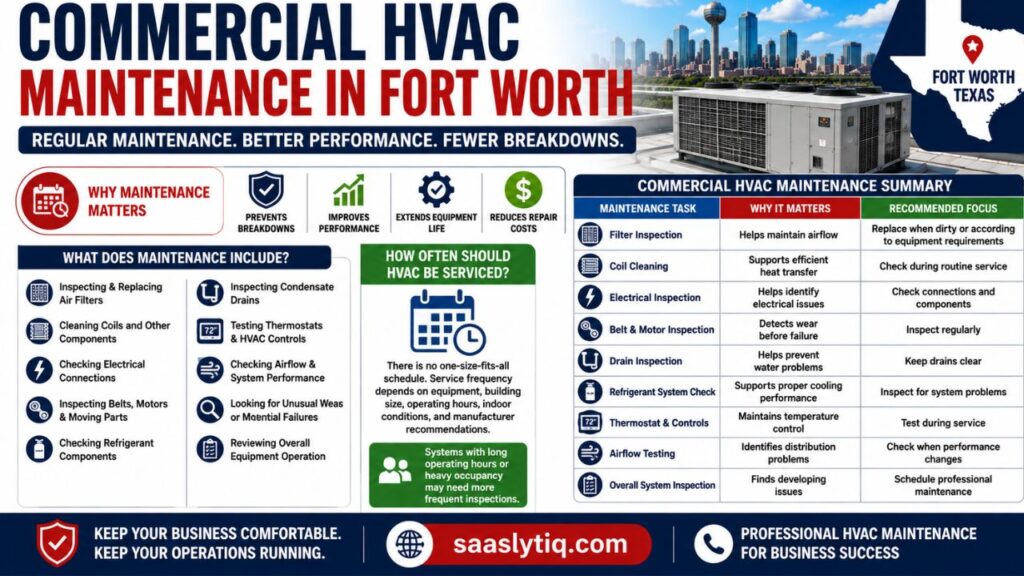
A professional maintenance visit should go beyond simply changing an air filter. Technicians can inspect major components, check system performance, identify wear, and make adjustments when needed. The exact maintenance requirements will depend on the type, age, size, and usage of the HVAC equipment.
What Does Commercial HVAC Maintenance Include?
A typical maintenance service may include:
- Inspecting and replacing air filters
- Cleaning coils and other accessible components
- Checking electrical connections
- Inspecting belts, motors, and moving parts
- Checking refrigerant-related components
- Inspecting condensate drains
- Testing thermostats and HVAC controls
- Checking airflow and system performance
- Looking for unusual wear or potential failures
- Reviewing overall equipment operation
How Often Should Commercial HVAC Be Serviced?
There is no single maintenance schedule that works for every commercial property. Service frequency depends on the equipment, building size, operating hours, indoor conditions, manufacturer recommendations, and how heavily the system is used.
Systems with long operating hours or heavy occupancy may need more frequent inspections, based on the equipment and manufacturer’s recommendations.
Commercial HVAC Maintenance Summary
| Maintenance Task | Why It Matters | Recommended Focus |
| Filter inspection | Helps maintain airflow | Replace when dirty or according to equipment requirements |
| Coil cleaning | Supports efficient heat transfer | Check during routine service |
| Electrical inspection | Helps identify electrical issues | Check connections and components |
| Belt & motor inspection | Detects wear before failure | Inspect regularly |
| Drain inspection | Helps prevent water problems | Keep drains clear |
| Refrigerant system check | Supports proper cooling performance | Inspect for system problems |
| Thermostat & controls | Maintains temperature control | Test during service |
| Airflow testing | Identifies distribution problems | Check when performance changes |
| Overall system inspection | Finds developing issues | Schedule professional maintenance |
How Much Does Commercial HVAC Cost in Fort Worth?
The cost of commercial HVAC service in Fort Worth can vary significantly from one business to another. A simple repair on a small rooftop unit will typically have very different costs from replacing a large commercial system, installing multiple units, or upgrading HVAC equipment throughout an entire building.
Rather than relying on a single price range, businesses should consider the factors that influence the total project cost. Getting a detailed estimate from a qualified commercial HVAC contractor can make it easier to understand what you are paying for and compare different options.
Factors That Affect Commercial HVAC Costs
Several factors can influence the final price of commercial HVAC work:
- Building size: Larger buildings generally require more equipment and greater heating and cooling capacity.
- System type: Rooftop units, VRF systems, chillers, boilers, and other commercial equipment have different installation and service requirements.
- Repair complexity: A minor component replacement will cost less than a major compressor, motor, or control-system repair.
- Equipment efficiency: Higher-efficiency equipment may have a higher upfront cost but can potentially reduce energy consumption over time.
- Installation requirements: Ductwork, electrical work, controls, ventilation, and equipment access can all affect installation costs.
- Labor and accessibility: Difficult-to-access equipment or complex commercial installations may require additional labor.
- Maintenance needs: Larger or heavily used systems may require more frequent professional maintenance.
Commercial HVAC Cost Factors
| Service | Main Cost Factors |
| HVAC Repair | Parts, labor, equipment type, and repair complexity |
| Preventive Maintenance | System size, equipment condition, and service frequency |
| HVAC Installation | Equipment, labor, ductwork, controls, and building requirements |
| System Replacement | Unit capacity, efficiency, removal, installation, and modifications |
| Chiller Service | System size, components, labor, and specialized equipment |
| Emergency Service | Timing, urgency, equipment problem, and required repairs |
Businesses should also look beyond the initial price when comparing HVAC options. A lower-cost system or repair may not provide the best long-term value if it requires frequent repairs or consumes significantly more energy.
Before approving commercial HVAC work, ask for a written estimate that clearly explains the equipment, labor, parts, warranties, and any additional charges. For larger installations or replacements, it can also be useful to compare multiple professional proposals.
The right approach is to consider upfront cost, expected operating expenses, equipment reliability, maintenance requirements, and long-term value rather than choosing a contractor based solely on the lowest quote.
What Should Be Included in a Commercial HVAC Quote?
Don’t compare commercial HVAC quotes based on the final price alone. Two contractors may provide very different proposals even when the total numbers initially look similar. Check whether the quote includes equipment, labor, removal of existing equipment, installation, electrical or ductwork modifications, controls, testing, warranty coverage, and any additional charges.
How to Choose a Commercial HVAC Contractor in Fort Worth
Choosing the right commercial HVAC contractor is an important decision for any business. Commercial HVAC systems are often more complex and expensive than residential equipment, so the contractor you choose should have experience working with the type of system and building you operate.
Instead of choosing a company based only on the lowest price, look at its experience, qualifications, service options, communication, and overall value.
Check Licensing and Insurance
Before hiring a contractor, verify that the company has the appropriate Texas licensing and insurance for the work it performs. Proper credentials can provide greater confidence that the contractor understands applicable requirements and professional standards.
Look for Commercial HVAC Experience
Commercial HVAC systems can include rooftop units, packaged systems, VRF/VRV equipment, chillers, boilers, air handlers, and building controls. Ask whether the contractor has experience servicing the specific equipment installed in your facility.
Experience with similar commercial buildings can also be valuable because an office, restaurant, warehouse, and industrial facility may have very different HVAC requirements.
Ask About Emergency HVAC Service
An HVAC failure can quickly become a business problem, particularly during periods of extreme weather. If your business operates outside standard working hours, ask whether the contractor provides emergency commercial HVAC service and what response options are available.
Request a Written Estimate
A professional estimate should clearly explain what is included in the proposed work. Depending on the project, this may include:
- Equipment and parts
- Labor
- Installation or repair work
- Removal of existing equipment
- Ductwork or electrical modifications
- Controls and testing
- Warranty information
- Additional potential charges
A detailed estimate makes it easier to compare contractors and avoid unexpected costs.
Ask About Preventive Maintenance Programs
A contractor that offers a commercial HVAC maintenance program can help your business move from reactive repairs to planned maintenance. Ask what inspections are included, how often service is performed, and whether the agreement covers emergency response or discounts on repairs.
Consider Reviews and References
Online reviews can provide useful insight into a company’s communication, punctuality, workmanship, and customer service. For larger commercial projects, you may also want to ask for references from businesses with similar HVAC requirements.
Contractor Selection Checklist
| What to Check | Why It Matters |
| Commercial experience | Shows familiarity with larger and more complex HVAC systems |
| Licensing & insurance | Helps verify professional qualifications |
| System expertise | Ensures the contractor understands your specific equipment |
| Written estimates | Makes costs and project scope clearer |
| Emergency availability | Helps reduce downtime during unexpected failures |
| Maintenance programs | Supports long-term system reliability |
| Reviews & references | Provides insight into previous customer experiences |
| Warranty information | Clarifies protection after repair or installation |
The best commercial HVAC contractor is not necessarily the cheapest option. Look for a company that understands your building, communicates clearly, provides transparent pricing, and can support your HVAC system beyond a single repair.
Commercial HVAC Repair vs. Replacement: Which Is Better?
When a commercial HVAC system develops a problem, one of the first decisions a business owner or facility manager faces is whether to repair the existing equipment or replace it. The right choice depends on the system’s condition, repair history, operating costs, and the expected cost of keeping the equipment in service.
When Repair May Make Sense
Repairing the system can be a practical option when the problem is relatively minor and the equipment is otherwise performing well. A repair may be worth considering when:
- The system is in reasonably good condition
- The problem is limited to one component
- Repair costs are manageable
- The equipment still operates efficiently
- Major components are not showing signs of failure
- The system has not required frequent repairs
For example, replacing a failed electrical component or repairing a relatively small airflow problem may be more economical than replacing an otherwise reliable HVAC system.
When Replacement May Be the Better Option
Replacement may deserve consideration when the equipment has become unreliable or expensive to maintain. Warning signs can include:
- Frequent or repeated breakdowns
- Increasing repair costs
- Rising energy consumption
- Difficulty maintaining comfortable temperatures
- Major component failures
- Outdated or inefficient equipment
- Ongoing performance problems
A newer system may offer improved efficiency, better temperature control, and more reliable operation. However, replacement should be based on the overall condition and economics of the equipment rather than age alone.
Repair vs. Replacement Summary
| Consider Repair When | Consider Replacement When |
| Problem is isolated | Breakdowns happen frequently |
| Equipment performs well overall | Major components are failing |
| Repair cost is reasonable | Repair costs continue increasing |
| System is relatively efficient | Energy costs are rising |
| Few previous repairs | System has ongoing performance issues |
If you’re unsure which option makes sense, ask a qualified commercial HVAC professional to inspect the equipment and explain both options. A good recommendation should consider the immediate repair cost as well as expected maintenance, energy use, reliability, and future replacement needs.
Why Preventive Maintenance Matters
Preventive maintenance helps businesses identify worn components, airflow problems, electrical issues, and other developing concerns before they lead to major disruptions. For commercial properties in Fort Worth, this can be particularly useful when HVAC equipment is working under heavy cooling demand.
Key Benefits of Preventive HVAC Maintenance
- Fewer unexpected breakdowns: Regular inspections can identify potential problems before they cause a complete failure.
- Better system performance: Cleaning, adjustments, and routine inspections can help equipment operate as intended.
- Improved energy efficiency: Addressing airflow and equipment problems may help prevent the system from working harder than necessary.
- Longer equipment life: Proper maintenance can help reduce unnecessary wear on important components.
- Better comfort: Well-maintained equipment can provide more consistent heating and cooling throughout the building.
- Better budgeting: Planned maintenance can make HVAC expenses more predictable and help businesses identify replacement needs earlier.
Preventive maintenance should not be viewed simply as another operating expense. It can be part of a broader strategy for protecting equipment, reducing avoidable downtime, and maintaining a comfortable commercial environment.
The best maintenance schedule depends on the type of HVAC system, building conditions, operating hours, and manufacturer recommendations. A commercial HVAC professional can help create a maintenance plan that fits the specific needs of your facility.
Frequently Asked Questions About Commercial HVAC in Fort Worth
How often should a commercial HVAC system be serviced?
The ideal service frequency depends on the equipment, building size, operating hours, and manufacturer recommendations. Systems that operate for long hours or handle heavy cooling loads may require more frequent inspections. Seasonal maintenance can also help prepare equipment for periods of high demand.
What is the most common commercial HVAC system in Fort Worth?
Rooftop units and packaged HVAC systems are common in many commercial properties because they can provide heating and cooling while saving valuable indoor space. However, larger buildings may use chillers, air handlers, VRF systems, boilers, or combinations of several HVAC technologies.
When should a business replace its commercial HVAC system?
Replacement may be worth considering when a system has frequent breakdowns, rising repair costs, poor efficiency, inconsistent temperatures, or major component failures. The decision should consider the equipment’s overall condition and long-term operating costs rather than age alone.
How long does commercial HVAC installation take?
Installation time varies depending on the size and complexity of the project. Replacing a single rooftop unit may be relatively straightforward, while installing a new system throughout a large commercial building can require significantly more time. Ductwork, electrical work, controls, equipment availability, and site conditions can all affect the schedule.
Do commercial HVAC companies provide emergency service?
Some commercial HVAC contractors offer emergency or after-hours service, while others operate during standard business hours. Businesses that depend heavily on their HVAC systems should ask about emergency response options before choosing a contractor.
How can businesses reduce commercial HVAC energy costs?
Regular maintenance is a good starting point. Businesses can also look at equipment efficiency, proper airflow, thermostat and building controls, zoning, operating schedules, and the condition of insulation and ductwork. An HVAC professional can evaluate the system and identify opportunities to improve efficiency.
Conclusion
Reliable commercial HVAC is an important part of keeping a business comfortable, productive, and operational throughout the year. From routine maintenance and minor repairs to complete system installation and replacement, taking care of your HVAC equipment can help reduce unexpected breakdowns and maintain consistent indoor temperatures.
For businesses looking for commercial HVAC in Fort Worth, the right solution depends on the building, equipment, operating requirements, and long-term goals. Regular maintenance, timely repairs, and professional system evaluations can help you make informed decisions and avoid unnecessary HVAC expenses.
Whether you manage an office, restaurant, retail store, warehouse, healthcare facility, or another commercial property, choosing an experienced HVAC contractor can make a significant difference. Focus on reliable service, transparent pricing, commercial experience, and long-term support rather than simply choosing the lowest-cost option.