
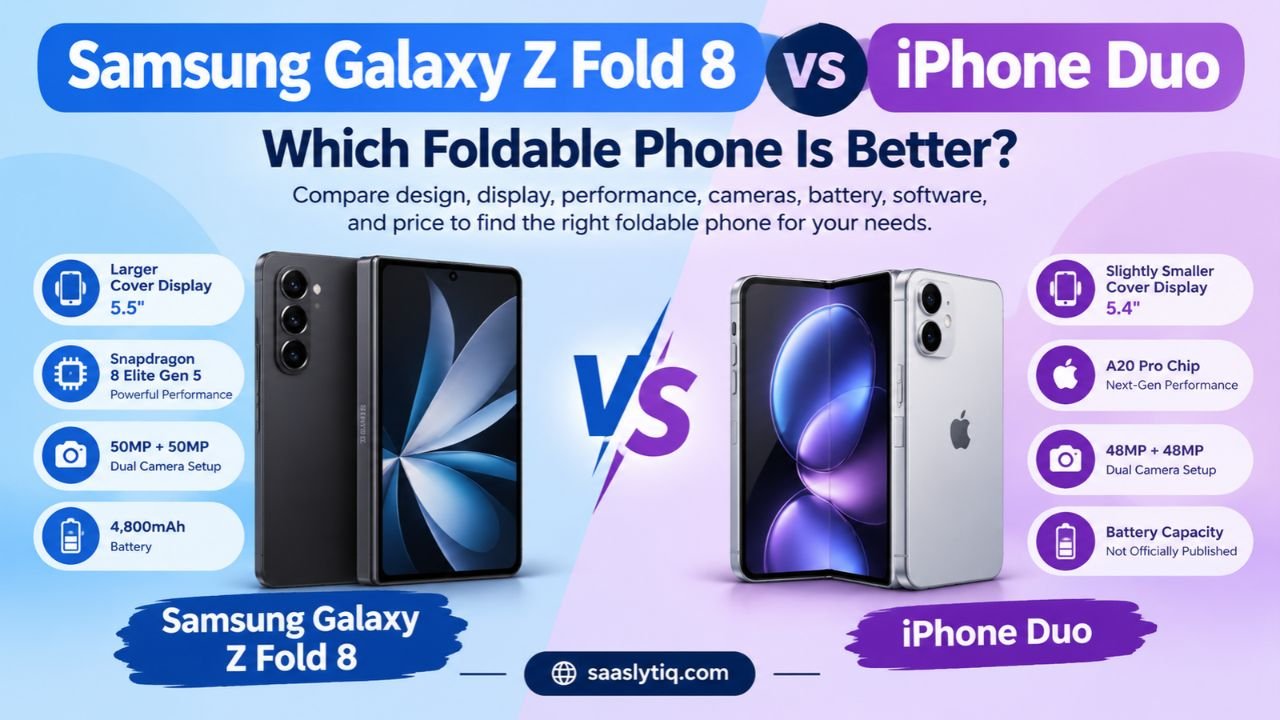
Foldable smartphones are becoming a practical choice for people who want a large display without carrying a separate tablet. Two devices attracting attention in this category are the Samsung Galaxy Z Fold 8 and Apple iPhone Duo. Both combine a conventional smartphone experience with a larger screen that opens for reading, gaming, video streaming, and multitasking.
However, these phones take different approaches to design, software, and everyday use. Samsung focuses on Android flexibility, a lightweight foldable design, and multitasking features. Apple combines its first foldable iPhone with iOS, the A20 Pro chip, and integration with its existing ecosystem.
This Samsung Galaxy Z Fold 8 vs iPhone Duo comparison examines their main specifications, display quality, performance, cameras, battery life, software, and prices to help readers decide which device better suits their needs.
Samsung Galaxy Z Fold 8 vs iPhone Duo: Quick Comparison
The table below highlights the key differences between the two foldable phones. Specifications are based on manufacturer information and published product details available as of October 2026.
| Feature | Samsung Galaxy Z Fold 8 | Apple iPhone Duo |
|---|---|---|
| Design | Book-style foldable | Book-style foldable |
| Main display | 7.6-inch | 7.6-inch |
| Cover display | 5.5-inch | 5.4-inch |
| Display technology | Dynamic AMOLED 2X | Super Retina XDR OLED |
| Refresh rate | Adaptive, up to 120Hz | ProMotion, up to 120Hz |
| Processor | Snapdragon 8 Elite Gen 5 for Galaxy | Apple A20 Pro |
| Main camera | 50MP | 48MP |
| Ultra-wide camera | 50MP | 48MP |
| Battery | 4,800mAh | Capacity not officially published |
| Weight | 201g | 254g |
| Operating system | Android 17 with One UI 9 | iOS 27 |
| Starting US price | $1,899.99 list price | $1,999 |
| Best suited for | Android multitasking and portability | Apple ecosystem and iOS users |
Prices may change with promotions, storage options, trade-ins, and retailer availability. Battery capacities should not be compared directly when one manufacturer has not published a capacity figure.
1. Design and Build Quality
Design is one of the biggest differences between the Samsung Galaxy Z Fold 8 and iPhone Duo. Both phones fold horizontally, giving users a regular smartphone-sized experience when closed and a larger workspace when opened.
Samsung’s Galaxy Z Fold 8 weighs approximately 201 grams. Its lighter construction makes it easier to carry throughout the day, particularly for users who frequently switch between one-handed phone use and a larger display. The device also has a wider cover-screen format and a main display designed for reading, browsing, and running multiple applications.
The iPhone Duo takes a different approach. It weighs approximately 254 grams and uses a titanium frame with Apple’s folding hinge design. Its outer screen measures 5.4 inches, while the unfolded screen measures 7.6 inches. Apple also highlights a nano-texture finish designed to reduce glare and make the inner display’s crease less noticeable.
For buyers who value portability, Samsung has an advantage because of its lower weight and slimmer dimensions. Apple may appeal more to users who prefer Apple’s hardware design and want to remain within the iPhone ecosystem.
Both devices contain moving hinge mechanisms and flexible displays. Buyers should still use suitable protective accessories and review the manufacturer’s warranty terms before purchasing either phone.
2. Display Quality and Screen Size
The main displays on both phones measure 7.6 inches, making them suitable for tasks that benefit from extra screen space. Users can read long documents, view websites, edit files, watch videos, and work with multiple applications without relying entirely on a conventional phone screen.
Samsung uses a Dynamic AMOLED 2X panel, while Apple uses a Super Retina XDR OLED display. Both support refresh rates of up to 120Hz, which can make scrolling, animations, and compatible games appear smoother than on a standard 60Hz display.
The cover screens are slightly different. Samsung provides a 5.5-inch outer display, compared with the iPhone Duo’s 5.4-inch screen. This small difference may affect how comfortable users find typing, browsing, or responding to messages while the phone is closed, although screen shape and software layout also matter.
Apple advertises peak outdoor brightness of up to 3,000 nits for the Duo’s displays. Actual brightness depends on usage conditions and content. Samsung also advertises high brightness for its foldable display, but brightness figures should be compared under equivalent testing conditions rather than treated as a guarantee of identical real-world performance.
Which display is better?
The best choice depends on personal preference. Samsung’s wider foldable layout may suit users who want a flexible workspace, while Apple’s display technology and glare-reduction features may appeal to people who read or watch content in different lighting conditions.
3. Performance and Processor
Performance affects how quickly a phone opens applications, handles demanding games, processes photographs, and manages several tasks at once.
The Samsung Galaxy Z Fold 8 uses the Snapdragon 8 Elite Gen 5 for Galaxy processor. It is designed to support demanding applications, advanced mobile gaming, image processing, and AI-powered features. Samsung also combines its hardware with Galaxy AI tools and Android-based software features.
The iPhone Duo runs Apple’s A20 Pro chip and iOS 27. Apple designed the device to support demanding applications, graphics-intensive tasks, and its software ecosystem. Its custom processor and hardware-software integration may offer strong performance, but a definitive performance winner requires independent benchmark results and comparable real-world testing.
Processor names alone do not tell the full story. Memory management, thermal performance, software optimization, and application compatibility can all influence how a phone performs during extended use.
For gaming, both devices offer large displays that can improve the experience. Buyers should also consider game availability, controller support, sustained performance, and how comfortable each phone feels during long gaming sessions.
4. Camera Comparison
Camera quality depends on more than megapixel counts. Sensor size, image processing, stabilization, lens selection, and software can have a major effect on the final photograph.
The Galaxy Z Fold 8 features a 50MP main camera and a 50MP ultra-wide camera. It is designed to capture everyday photographs, wider landscapes, group pictures, and video. Samsung also includes Galaxy camera software and AI-powered tools for supported photography and video workflows.
The iPhone Duo has a 48MP main camera and a 48MP ultra-wide camera. Apple highlights its image-processing system, optical-quality 2x zoom, and camera features designed to work with the phone’s foldable form factor.
The available specifications do not establish that one phone consistently takes better photographs. A fair comparison should include daylight images, low-light photographs, moving subjects, portraits, video stabilization, and front-camera performance.
Neither standard model should automatically be treated as a replacement for a dedicated telephoto-camera system. Buyers who regularly photograph distant subjects should check the precise zoom hardware and capabilities before choosing a device.
Which phone is better for photography?
Both phones have capable camera systems on paper. People who prioritize photography should wait for or consult independent side-by-side sample images and video tests rather than selecting a winner based only on megapixel numbers.
5. Battery Life and Charging
Battery performance is especially important for foldable phones because their large displays can consume considerable power during gaming, streaming, navigation, and multitasking.
Samsung lists a 4,800mAh battery for the Galaxy Z Fold 8. The company also publishes its own video-playback estimates, but actual battery life will vary according to screen brightness, network conditions, application use, and settings.
Apple has not published a battery-capacity figure for the iPhone Duo in the same format. Instead, Apple provides usage and video-playback estimates. These figures cannot be compared directly with Samsung’s battery capacity because milliamp-hours measure battery capacity, not how long a device lasts in normal use.
Charging speed, wireless charging support, and included accessories can also influence the buying decision. Buyers should verify the supported charging standards, required adapter, and charging accessories for their region before purchasing.
For the most useful comparison, look for independent battery tests that use the same brightness settings, network conditions, and workloads on both phones.
6. Software and Multitasking
Software is one of the most important differences between these devices. The Galaxy Z Fold 8 runs Android 17 with Samsung’s One UI 9 interface, while the iPhone Duo runs iOS 27.
Samsung’s foldable software is designed around a larger display. Users can work with multiple applications, switch between tasks, and use Galaxy AI features. Its Android foundation also offers flexibility in supported default applications, file management, and app installation options.
The iPhone Duo adapts Apple’s familiar iOS experience to a foldable design. It is a natural option for people who already use an iPhone, Mac, iPad, Apple Watch, or other compatible Apple products. The device also supports features designed for its larger screen, with Apple highlighting multitasking and future Apple Pencil support.
The better software experience depends on how someone works. Android may be preferable for people who want more customization and flexible file handling. iOS may be more convenient for users who already rely on Apple’s services and devices.
Before buying, check that the applications you use most frequently support the foldable screen layout and the multitasking features you need.
7. Storage Options and Price
Price matters because both devices occupy the premium smartphone category. Their total cost depends on storage capacity, promotions, retailer pricing, trade-in offers, and local taxes.
The Galaxy Z Fold 8 has a US list price starting at $1,899.99, while the iPhone Duo starts at $1,999. At these starting prices, the iPhone Duo costs approximately $100 more. Actual prices may differ during sales or after trade-in discounts.
The iPhone Duo also offers a 2TB storage option, while the Galaxy Z Fold 8’s listed configurations go up to 1TB. More storage can be useful for people who record large video files, download games, or keep extensive offline media libraries.
| Buying consideration | Galaxy Z Fold 8 | iPhone Duo |
|---|---|---|
| Starting US list price | $1,899.99 | $1,999 |
| Maximum listed storage | 1TB | 2TB |
| Best value depends on | Discounts and storage needs | Storage needs and Apple ecosystem |
| Extra costs to check | Case, charger, warranty | Case, charger, warranty |
These prices are US launch/list prices, not guaranteed prices in every country. Buyers in other markets should check local availability, warranty coverage, import costs, and repair support.
8. Durability and Repair Considerations
A foldable phone has more complex hardware than a conventional smartphone. Its hinge and flexible inner display need careful handling, and repairing these components may be more expensive than repairing a standard phone screen.
Apple lists an IP68 rating for the iPhone Duo, indicating a tested level of resistance to dust and water under specified laboratory conditions. This rating does not mean the device is waterproof or immune to damage from liquids.
Buyers should verify the Galaxy Z Fold 8’s official regional durability specifications and compare them with Apple’s published rating. Different IP ratings may measure different forms of protection, so the numbers should not be treated as interchangeable.
Before buying either phone, review the warranty exclusions, accidental-damage protection options, screen-repair costs, and availability of authorized repair services. This is especially important if the phone will be used heavily for work or travel.
9. Which Phone Is Better for Different Users?
The right foldable phone depends on a user’s existing devices, daily routine, and priorities.
Choose the Samsung Galaxy Z Fold 8 if:
- You prefer Android and Samsung’s One UI interface.
- You want a lighter foldable phone.
- You regularly use split-screen applications or other multitasking features.
- You prefer Samsung’s approach to customization and file management.
- You find a current Samsung discount that makes it better value for your budget.
Choose the Apple iPhone Duo if:
- You already use an iPhone and want to stay with iOS.
- You rely on compatible Apple devices and services.
- You want Apple’s first foldable iPhone experience.
- You need the available 2TB storage configuration.
- You value the iPhone Duo’s published display, design, and camera features.
Wait before buying if:
- You need proven long-term hinge durability.
- Camera quality is your main priority and independent comparisons are not yet available.
- You want verified real-world battery results.
- You need the lowest possible price and can wait for discounts.
10. Final Verdict: Samsung Galaxy Z Fold 8 vs iPhone Duo
The Samsung Galaxy Z Fold 8 and Apple iPhone Duo offer two different approaches to the premium foldable smartphone market. Samsung’s phone is lighter and starts at a lower US list price. Its Android software and foldable multitasking features make it worth considering for people who want a flexible mobile workspace.
The iPhone Duo is a strong option for people who prefer iOS and already use Apple’s ecosystem. It offers a 7.6-inch inner display, Apple’s A20 Pro processor, a dual 48MP rear-camera system, and a storage configuration reaching 2TB.
There is no universal winner for every buyer. The Galaxy Z Fold 8 is the more natural choice for many Android users, while the iPhone Duo is the logical option for people who want a foldable iPhone. Before making a final decision, compare independent battery tests, camera samples, durability results, local prices, and repair costs.
Frequently Asked Questions
Is the Samsung Galaxy Z Fold 8 better than the iPhone Duo?
Neither phone is better in every category. Samsung offers a lighter design and Android flexibility, while Apple offers an iOS experience and deeper integration with compatible Apple devices. The best option depends on your priorities.
Which phone has the bigger display?
Both phones have a 7.6-inch inner display. Samsung has a 5.5-inch cover display, while the iPhone Duo has a 5.4-inch outer display.
Which is cheaper, the Galaxy Z Fold 8 or iPhone Duo?
The Galaxy Z Fold 8 has a US list price starting at $1,899.99, compared with $1,999 for the iPhone Duo. Retailer discounts and local pricing can change the difference.
Does the iPhone Duo have a better camera?
The iPhone Duo has a 48MP main camera and a 48MP ultra-wide camera. Samsung has a 50MP main camera and a 50MP ultra-wide camera. Megapixel counts alone do not establish which camera performs better, so independent photo and video tests are important.
Which phone has better battery life?
A definitive winner requires comparable independent testing. Samsung publishes a 4,800mAh battery capacity, while Apple provides its own usage estimates without publishing the capacity in the same format. Battery performance varies with settings and usage.
Is the iPhone Duo worth buying?
It may be worth considering if you prefer iOS, use other Apple products, and want a foldable iPhone. Buyers should also compare its price, weight, repair costs, and real-world performance with alternatives.
Should I buy the Galaxy Z Fold 8 or wait?
If you need an Android foldable now and the price suits your budget, the Galaxy Z Fold 8 is worth considering. If you are uncertain about Apple’s first foldable design, waiting for more long-term durability and battery testing can help you make a more informed decision.