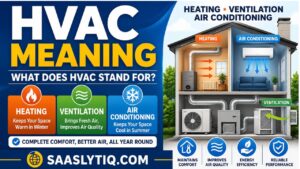


If you have ever wondered what HVAC means, the answer is simple: HVAC stands for Heating, Ventilation, and Air Conditioning. It refers to the systems used to control indoor temperature, move air, and maintain a comfortable indoor environment. While many people use HVAC and air conditioning interchangeably, HVAC is actually a broader term that includes both heating and cooling, along with ventilation and air circulation.
An HVAC system can include several components working together, such as a furnace or heat pump for heating, an air conditioner for cooling, ductwork for distributing air, filters for removing airborne particles, and a thermostat for controlling temperature. The exact setup depends on the building, climate, and comfort requirements.
In this guide, we’ll explain the HVAC meaning in simple terms, break down what each part of the acronym represents, explain how HVAC systems work, explore the main types of HVAC systems, and clarify the difference between HVAC and AC.
What Does HVAC Stand For?
HVAC stands for Heating, Ventilation, and Air Conditioning. These three functions work together to keep indoor spaces comfortable throughout the year. Although the term may sound technical, the basic idea is straightforward: an HVAC system helps control the temperature, movement, and quality of air inside a building.
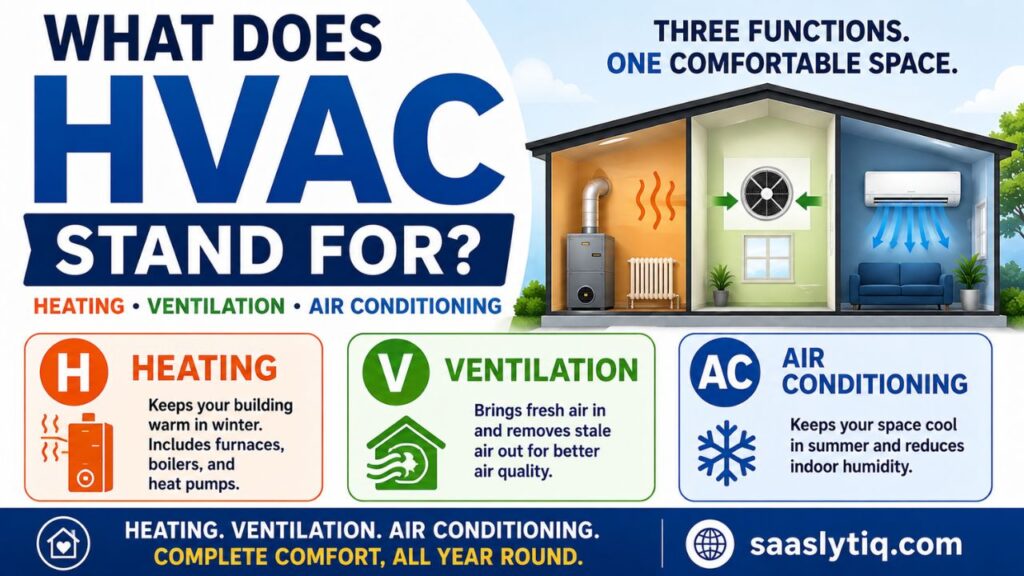
H — Heating
Heating is the part of an HVAC system responsible for keeping a building warm when outdoor temperatures drop. Common heating equipment includes furnaces, boilers, and heat pumps.
For example, a furnace heats air and sends it through the building’s ductwork. A heat pump works differently by transferring heat from one place to another, but the goal is the same—to maintain a comfortable indoor temperature.
V — Ventilation
Ventilation is about moving fresh air into a building and removing stale indoor air. This is an important part of HVAC that is often overlooked.
Without proper ventilation, indoor air can become stagnant, especially in tightly closed buildings. Ventilation systems use fans, ducts, vents, and sometimes dedicated fresh-air equipment to improve air circulation.
AC — Air Conditioning
Air conditioning handles more than simply blowing cold air. An AC system removes heat from indoor air, releases that heat outdoors, and can also reduce indoor humidity.
During a hot day, for example, the air conditioner takes warm indoor air, removes its heat, and sends cooler air back into space.
How the Three Work Together
The real value of HVAC comes from combining these functions. Heating keeps the building warm in colder weather, air conditioning keeps it cool in hot weather, and ventilation helps maintain continuous air movement.
A useful way to remember it: HVAC isn’t just one machine. It’s an overall system designed to create and maintain a comfortable indoor environment.
What Is an HVAC System?
An HVAC system is a group of equipment and components that work together to control the indoor environment of a building. Depending on the setup, it can heat the space during cold weather, cool it during hot weather, circulate air, control humidity, and help maintain better indoor air quality.
One important thing to understand is that HVAC does not refer to a single piece of equipment. A typical system may include a furnace or heat pump, air conditioner, thermostat, air handler, filters, ductwork, vents, and other components. Each part has a specific job, but they need to work together for the system to operate properly.
For example, when a thermostat detects that a room is warmer than the temperature you’ve selected, it can signal the cooling system to start. The system removes heat from the indoor air, and a blower pushes the conditioned air through the ductwork and into different rooms. Once the desired temperature is reached, the system cycles down.
The exact design of an HVAC system depends on the building. A small home may use a simple split system, while a large office, restaurant, hospital, or warehouse may require more sophisticated equipment and controls.
HVAC Is More Than Air Conditioning
A common misunderstanding is that HVAC simply means air conditioning. Air conditioning is only one part of HVAC.
Think of it this way:
- Heating keeps indoor spaces warm.
- Ventilation manages fresh-air exchange and air circulation.
- Air conditioning removes heat and cools indoor spaces.
Together, these functions help maintain a more comfortable and controlled indoor environment. That’s why the term HVAC is used when discussing the complete heating, cooling, and ventilation setup rather than just the air conditioner.
How Does an HVAC System Work?
An HVAC system works by heating, cooling, and moving air throughout a building based on the temperature and comfort settings selected on the thermostat. While the equipment behind it can be complex, the basic process is easier to understand when you break it into a few steps.
1. The Thermostat Detects the Temperature
The process usually starts with the thermostat. It measures the indoor temperature and compares it with the temperature you’ve selected.
For example, if the thermostat is set to 72°F but the room reaches 76°F, it signals the cooling system to start. When the indoor temperature reaches the desired level, the system can cycle off.
2. The HVAC System Heats or Cools the Air
Depending on the season and system type, the equipment either adds or removes heat.
During winter, a furnace, boiler, or heat pump can provide heating. During summer, an air conditioner or heat pump can remove heat from indoor air.
With a cooling system, the air conditioner absorbs heat from the indoor air and transfers that heat outside. The result is cooler air that can be circulated back into the building.
3. Air Is Filtered and Moved
Before conditioned air reaches different rooms, it may pass through an air filter that captures dust and other airborne particles.
A blower or air handler then moves the air through the system. In buildings with ductwork, the conditioned air travels through ducts before reaching individual rooms through vents or registers.
4. Conditioned Air Is Distributed
The system distributes heated or cooled air throughout the building. Return vents bring indoor air back toward the HVAC equipment, where it can be conditioned again.
This continuous circulation helps maintain a more consistent indoor temperature instead of treating each room as a completely separate space.
5. The System Adjusts as Conditions Change
HVAC operation doesn’t simply happen once and stop. The system continually responds to temperature changes, thermostat settings, and sometimes humidity or ventilation requirements.
Human insight: If one room is consistently warmer or colder than the rest of the building, the problem may not always be the thermostat. Poor airflow, blocked vents, ductwork issues, insulation, or an incorrectly sized system can also affect comfort.
HVAC System Working Process: Quick Summary
| Step | What Happens | Main Component Involved |
| 1. Temperature Detection | The system checks the indoor temperature against the thermostat setting. | Thermostat |
| 2. Heating or Cooling | The system adds or removes heat based on the temperature requirement. | Furnace, Heat Pump, or AC |
| 3. Air Filtering | Air passes through a filter to capture dust and other particles. | Air Filter |
| 4. Air Movement | Conditioned air is pushed through the system and ductwork. | Blower / Air Handler |
| 5. Air Distribution | Heated or cooled air reaches different rooms through vents and registers. | Ductwork & Vents |
| 6. Return & Adjustment | Indoor air returns to the system, and the HVAC adjusts as conditions change. | Return Ducts & Thermostat |
In simple terms, an HVAC system follows a repeating cycle: detect the indoor conditions, heat or cool the air, filter and move it through the building, distribute it where needed, and adjust as conditions change.
What Are the Main Components of an HVAC System?
An HVAC system may look like one complete unit from the outside, but several components work together behind the scenes. Each part has a specific job, and a problem with one component can affect the performance of the entire system.
The exact components vary depending on the type of HVAC system, but most systems include some combination of the following.
Thermostat
The thermostat is essentially the control center of the HVAC system. It monitors indoor temperature and tells the system when to heat or cool.
Modern programmable and smart thermostats can also adjust temperatures according to schedules, occupancy, or other settings, which can help improve comfort and energy management.
Furnace or Heat Pump
The furnace is commonly used to provide heat in many HVAC systems. It heats air and sends it through the ductwork to different parts of the building.
A heat pump works differently. Instead of generating heat in the same way as a furnace, it transfers heat from one location to another. Depending on the system, a heat pump can provide both heating and cooling.
Air Conditioner
The air conditioner is responsible for cooling indoor spaces. It removes heat from indoor air and transfers that heat outdoors.
A typical central AC system includes components such as an evaporator coil, condenser, compressor, and refrigerant circuit that work together during the cooling process.
Air Handler and Blower
The air handler contains equipment that helps circulate conditioned air. The blower pushes air through the ductwork and into the rooms.
In some systems, the air handler may also contain components for filtering, heating, or cooling the air.
Ductwork
Ductwork is the network of passages that distributes conditioned air throughout a building. Supply ducts carry heated or cooled air to rooms, while return ducts bring air back toward the HVAC equipment.
Poorly designed, damaged, or leaking ducts can reduce airflow and make it harder for the system to maintain consistent temperatures.
Air Filter
The air filter captures dust, dirt, and other particles as air passes through the HVAC system. A dirty or clogged filter can restrict airflow and force the equipment to work harder.
That’s why filter condition should not be overlooked when troubleshooting an HVAC system.
Evaporator Coil and Condenser
In a typical cooling system, the evaporator coil absorbs heat from indoor air, while the condenser coil releases that heat outdoors.
These components play a central role in the refrigeration cycle that allows an air conditioner to cool a building.
How These Components Work Together
The important point is that no single component does everything. The thermostat calls for heating or cooling, the HVAC equipment conditions the air, the blower moves it, the ductwork distributes it, and the return system brings air back for another cycle.
Human insight: When an HVAC system isn’t performing properly, replacing the entire unit isn’t always the answer. Sometimes the underlying issue is something much simpler, such as restricted airflow, a dirty filter, poor ductwork, or a faulty thermostat. A proper inspection can help identify the actual cause before expensive equipment is replaced.
What Are the Different Types of HVAC Systems?
Not every building needs the same type of HVAC system. A small home, a multi-story office, and a large warehouse can have very different heating and cooling requirements. Factors such as building size, layout, climate, available space, and energy goals all influence which system makes sense.
Here are some of the most common types of HVAC systems.
Split HVAC Systems
A split system separates major components between indoor and outdoor units. The outdoor unit typically contains the condenser and compressor, while the indoor unit may include the evaporator coil and air handler or furnace.
Split systems are common in homes and smaller buildings because they can provide both heating and cooling without requiring all equipment to occupy the same space.
Packaged HVAC Systems
With a packaged system, most of the major heating and cooling components are housed in a single outdoor cabinet. These systems are often installed on rooftops or beside buildings.
Packaged units can be useful when indoor mechanical-room space is limited. They are also widely used in certain commercial buildings where rooftop installation makes equipment easier to access without taking up interior floor space.
Heat Pump Systems
A heat pump can provide both cooling and heating by transferring heat rather than producing it in the same way a traditional furnace does.
During warm weather, it moves heat from indoors to outdoors. In heating mode, the process reverses, allowing the system to bring heat indoors.
This makes heat pumps a versatile option for buildings that need year-round temperature control.
Ductless Mini-Split Systems
Ductless mini-splits are designed for buildings or spaces where traditional ductwork isn’t practical. They usually consist of an outdoor unit connected to one or more indoor units.
They can be particularly useful for room additions, individual offices, converted spaces, or buildings where installing new ducts would be difficult.
Central HVAC Systems
A central HVAC system conditions air at a central location and distributes it throughout the building using ductwork. This approach allows one system to manage temperatures across multiple rooms or areas.
Central systems are common in residential and commercial applications, although their size and complexity can vary considerably.
Choosing the Right HVAC System
There isn’t one HVAC system that is automatically best for every building. A system that works well in a small house may be completely unsuitable for a large commercial facility.
Human insight: Equipment size matters just as much as equipment type. An oversized system may cycle on and off too frequently, while an undersized system may struggle to keep up with demand. Proper sizing and system design should come before choosing equipment based solely on its price or brand.
The right HVAC system should match the building’s actual heating, cooling, airflow, and ventilation requirements.
Quick Comparison of HVAC System Types
| HVAC System | Main Setup | Best For | Key Benefit |
| Split System | Separate indoor and outdoor units | Homes and small buildings | Reliable heating and cooling in one system |
| Packaged System | Major components housed in one outdoor cabinet | Commercial buildings and rooftops | Saves indoor space |
| Heat Pump | Transfers heat for both heating and cooling | Homes and buildings needing year-round comfort | Provides heating and cooling |
| Ductless Mini-Split | Outdoor unit connected to individual indoor units | Room additions, offices, and spaces without ducts | Flexible and easy to zone |
| Central HVAC | Central equipment distributes air through ductwork | Homes, offices, and larger buildings | Provides whole-building temperature control |
Quick takeaway: The right HVAC system depends on the building’s size, layout, climate, available space, and heating and cooling requirements. There is no single system that works best for every property.
What Is the Difference Between HVAC and AC?
People often use HVAC and AC as if they mean the same thing, but there is an important difference. AC stands for air conditioning, while HVAC stands for heating, ventilation, and air conditioning.
In simple terms, AC is mainly concerned with cooling indoor spaces, while HVAC refers to the broader system used to manage indoor temperature, airflow, and ventilation.
For example, an air conditioner can remove heat from a room and make the air cooler. An HVAC system may include that same air conditioner along with a furnace or heat pump for heating, ductwork for distributing air, ventilation equipment for bringing in fresh air, and a thermostat for controlling the system.
HVAC vs. AC: What’s the Difference?
| Feature | HVAC | AC |
| Full Meaning | Heating, Ventilation, and Air Conditioning | Air Conditioning |
| Main Purpose | Controls heating, cooling, ventilation, and air circulation | Primarily cools indoor spaces |
| Heating | Yes, depending on the system | Usually no |
| Ventilation | Can include ventilation | Not necessarily |
| Cooling | Yes | Yes |
| Common Components | Furnace, heat pump, AC, thermostat, ducts, filters, air handler | Compressor, condenser, evaporator coil, refrigerant system |
| Typical Use | Complete indoor climate control | Cooling and dehumidification |
Why the Difference Matters
Understanding the difference is useful when you’re discussing installation, repairs, or maintenance. If someone says their AC isn’t working, they may be talking specifically about the cooling function. If they say their HVAC system isn’t working, the issue could involve heating, cooling, airflow, ventilation, or another component.
Human insight: Think of HVAC as the complete system and AC as one part of that system. A house can have an air conditioner, but when you talk about the equipment responsible for heating, cooling, and moving air throughout the building, HVAC is the more accurate term.
So, while every AC system can be part of an HVAC setup, HVAC is much broader than AC.
Why Is HVAC Important?
HVAC systems do much more than make a room warmer in winter or cooler in summer. They help create a controlled indoor environment where temperature, airflow, and ventilation can be managed according to the needs of the building.
For most people, the value of HVAC becomes obvious when something goes wrong. A poorly performing system can leave rooms uncomfortable, create uneven temperatures, or make the building feel too humid or stuffy. A properly designed and maintained system, on the other hand, can provide consistent comfort without constantly demanding attention.
Maintains Indoor Comfort
The most obvious job of an HVAC system is controlling temperature. It can provide heating when outdoor temperatures fall and cooling when temperatures rise.
A properly sized system should be able to maintain a relatively consistent temperature without running excessively or struggling to meet demand.
Helps Manage Indoor Airflow
Good airflow is another important part of indoor comfort. HVAC equipment, fans, ductwork, and vents work together to move conditioned air throughout the building.
If airflow is restricted or poorly balanced, you may notice that one room feels comfortable while another remains noticeably warmer or colder.
Supports Ventilation
Ventilation helps replace stale indoor air with fresh outdoor air while removing unwanted air from occupied spaces. This is particularly important in buildings where doors and windows remain closed for long periods.
Ventilation requirements can vary significantly depending on the building type, occupancy, and system design.
Helps Control Humidity
Many cooling systems remove moisture from indoor air as they operate. Managing humidity can make a space feel more comfortable and can help protect building materials and furnishings from excessive moisture.
However, humidity control isn’t identical in every HVAC system, so the equipment and building design need to be considered together.
Can Improve Energy Management
An appropriately sized and properly maintained HVAC system can operate more efficiently than equipment that is poorly matched to the building.
Things such as thermostat settings, airflow, filter condition, ductwork, insulation, equipment efficiency, and maintenance can all influence how much energy an HVAC system uses.
Why Proper HVAC Design Matters
An HVAC system isn’t automatically effective simply because the equipment is new. System design, sizing, installation, and ongoing maintenance all matter.
Human insight: If an HVAC system constantly runs but still struggles to maintain the desired temperature, replacing it with a larger unit may not solve the real problem. Poor airflow, duct losses, incorrect sizing, insulation issues, or other building conditions could be contributing to the problem.
Ultimately, a good HVAC system should match the building rather than forcing the building to work around the HVAC equipment.
HVAC Maintenance: Why Does It Matter?
An HVAC system doesn’t usually go from working perfectly to completely broken without showing some warning signs. In many cases, declining performance happens gradually. Airflow becomes weaker, rooms become harder to cool or heat, energy use may increase, or the equipment may start making unusual sounds.
That’s why regular HVAC maintenance matters. Maintenance is not simply about changing an air filter once in a while. A proper inspection looks at the system as a whole and helps identify problems before they turn into expensive repairs.
What Does HVAC Maintenance Include?
The exact maintenance tasks depend on the type of system, but a professional service may include:
- Inspecting or replacing air filters
- Checking thermostat operation
- Cleaning coils and other accessible components
- Inspecting electrical connections
- Checking belts, motors, and moving parts
- Inspecting refrigerant-related components
- Checking airflow and system performance
- Inspecting ductwork and vents
- Looking for unusual wear or signs of damage
- Testing the system after maintenance
Common Signs Your HVAC System Needs Attention
You don’t always have to wait for a complete breakdown before calling a technician. Pay attention if you notice:
- Uneven temperatures between rooms
- Weak airflow from vents
- Unusual noises or odors
- Longer heating or cooling cycles
- Frequent system cycling
- Unexpected increases in energy consumption
- The system struggling to reach the thermostat setting
These signs don’t automatically mean the HVAC system needs to be replaced. Sometimes the cause is something relatively simple, such as a dirty filter, restricted airflow, thermostat problem, or component that needs adjustment.
HVAC Maintenance Quick Summary
| Maintenance Task | Why It Matters |
| Replace or inspect filters | Helps maintain proper airflow |
| Check thermostat | Ensures the system responds to temperature settings |
| Clean coils | Helps the system transfer heat effectively |
| Inspect electrical components | Helps identify loose or worn connections |
| Check airflow | Helps maintain consistent heating and cooling |
| Inspect moving parts | Helps identify wear before it becomes a larger problem |
| Check refrigerant-related components | Helps identify potential cooling-system issues |
| Test overall performance | Confirms that the system is operating as expected |
Human insight: One of the easiest HVAC mistakes to make is treating maintenance as something you only need after a problem appears. A small airflow issue or unusual noise may seem harmless today, but catching the underlying problem early can be much easier—and potentially less expensive—than dealing with a major failure later.
Regular maintenance should follow the manufacturer’s recommendations and the needs of the specific HVAC system. Older equipment, heavily used systems, and buildings with demanding heating or cooling loads may require closer attention.
Common HVAC Terms You Should Know
Once you understand the basic HVAC meaning, you’ll probably come across several technical terms when comparing systems, reading equipment specifications, or talking to an HVAC professional. Knowing what these terms mean can make those conversations much easier.
Here are some of the most common HVAC terms worth knowing:
| HVAC Term | What It Means | Why It Matters |
| HVAC | Heating, Ventilation, and Air Conditioning | Describes the overall system used to manage indoor comfort |
| AC | Air Conditioning | Refers primarily to equipment that cools indoor air |
| BTU | British Thermal Unit | Used to describe heating or cooling capacity |
| SEER | Seasonal Energy Efficiency Ratio | Indicates the cooling efficiency of certain air-conditioning systems |
| Heat Pump | A system that transfers heat between indoor and outdoor spaces | Can provide both heating and cooling |
| Thermostat | A device that monitors and controls temperature | Tells the HVAC system when to heat or cool |
| Air Handler | Equipment that circulates conditioned air | Helps move air through the building |
| Ductwork | A network of passages used to distribute air | Delivers conditioned air to different areas |
| Refrigerant | A substance used to transfer heat in cooling systems | Plays a key role in the cooling process |
| Air Filter | A filter that captures particles from moving air | Helps maintain airflow and cleaner system operation |
Why These Terms Matter
You don’t need to become an HVAC technician to understand these terms. However, knowing the basics can help when you’re comparing equipment, reading an HVAC quote, or trying to understand why a system isn’t performing as expected.
For example, BTU relates to capacity, while efficiency ratings such as SEER help describe how efficiently certain cooling equipment operates. These numbers shouldn’t be viewed in isolation, though. The right equipment still needs to be properly sized and matched to the building.
Human insight: A higher capacity or higher efficiency rating doesn’t automatically mean an HVAC system is the right choice. A professional should consider the building’s size, insulation, climate, ductwork, usage, and actual heating and cooling demand before recommending equipment.
Understanding the terminology gives you a better starting point, but the equipment should ultimately be selected based on the specific requirements of the building, not just one number on a specification sheet.
Frequently Asked Questions About HVAC
What does HVAC stand for?
HVAC stands for Heating, Ventilation, and Air Conditioning. It is a general term for systems that help control indoor temperature, airflow, ventilation, and, depending on the equipment, humidity.
What does HVAC mean in simple terms?
In simple terms, HVAC is the equipment and system used to heat, cool, and circulate air inside a building. Depending on the system, it may also help manage humidity and air filtration.
Is HVAC the same as AC?
No. AC means air conditioning, which mainly focuses on cooling indoor spaces. HVAC is a broader term that includes heating and ventilation in addition to air conditioning.
What are the main parts of an HVAC system?
The components vary by system, but common parts include a thermostat, heating equipment, cooling equipment, air handler or blower, ductwork, air filters, coils, and various controls. Not every HVAC system will contain every component listed above.
What are the most common types of HVAC systems?
Common HVAC configurations include split systems, packaged systems, heat pumps, ductless mini-splits, and central HVAC systems. The best option depends on factors such as building size, layout, climate, available space, and heating and cooling requirements.
Does HVAC include ventilation?
Yes. Ventilation is the V in HVAC, and ventilation equipment can introduce outdoor air while removing or exhausting indoor air. However, the exact ventilation setup depends on the building and HVAC system design.
How often should an HVAC system be maintained?
Maintenance schedules vary depending on the equipment, manufacturer recommendations, operating conditions, and how heavily the system is used. Filters may need attention more frequently, while professional inspections can be scheduled according to the system’s specific requirements.
Can an HVAC system improve indoor air quality?
Yes, HVAC systems can support indoor air quality through filtration, ventilation, and air circulation. However, the level of air-quality control depends on the system and components installed.
Conclusion
Understanding the HVAC meaning is easier when you look beyond the acronym. HVAC stands for Heating, Ventilation, and Air Conditioning, and it describes the systems used to control indoor temperature, airflow, and ventilation.
An HVAC system can include several components, from thermostats and air filters to furnaces, heat pumps, air conditioners, ductwork, and air handlers. Different buildings require different HVAC configurations, so the right system depends on the property’s size, layout, climate, and specific comfort requirements.
The key thing to remember is simple: AC is only one part of HVAC. HVAC is the broader system responsible for creating and maintaining a comfortable indoor environment.